Live Chat for Travel Agencies: A Complete Guide

Over the past decade, how you plan trips has changed more dramatically than almost anything else about the way we travel. No one wants to wait days for a callback from their agency, spend an hour searching FAQ pages hoping for a nugget of information in the fine print, or be left hanging on a layover when their flight is canceled and their next step is completely unknown. Whether they’re comparing flights at midnight, trying to confirm that the room they’ve just booked has a view of the ocean, or are stuck on a 6-hour layover, travelers expect instant answers from your travel business.

Nowhere is this expectation more crucial than in travel. When something goes wrong – a booking mistake, a forgotten deadline to cancel, or a delayed response during a travel crisis – it can mean more than lost revenue for your agency. It can mean a ruined vacation, a botched business trip, or the unraveling of a once-in-a-lifetime experience. The way that companies respond when travel hits a bump in the road matters – travelers remember and they tell other travelers through reviews, recommendations and social media.

In this guide we look at some of the biggest pain points that agencies struggle with today, and show how live chat is the most effective tool for solving them, then examine the tangible benefits that come with adding live chat support to your agency.

What Agencies Struggle With


1. Customers Expect Instant Answers, Around the Clock

Travel doesn’t run on a 9-to-5 clock, nor do customer questions. Travel delays hit at 3 AM, a quick visa question might pop up over a weekend when no one’s in the office, or a traveler at the airport may have a last-minute itinerary change and limited time to act. The limitations of phone calls (fixed operating hours) and email (daylong delays) mean that even when an agency responds diligently, they often can’t keep up with the unpredictable nature of travel planning and disruptions.

The consequences of falling behind quickly compound: bookings are abandoned mid-way, customers switch to agencies that offer immediate help, and social media fills up with angry reviews that can take years to overcome. Trust is hard to build in the travel industry; when trust erodes due to a lack of immediate assistance during critical moments, it leads to the permanent loss of future business.
2. High Volume of Repetitive Questions

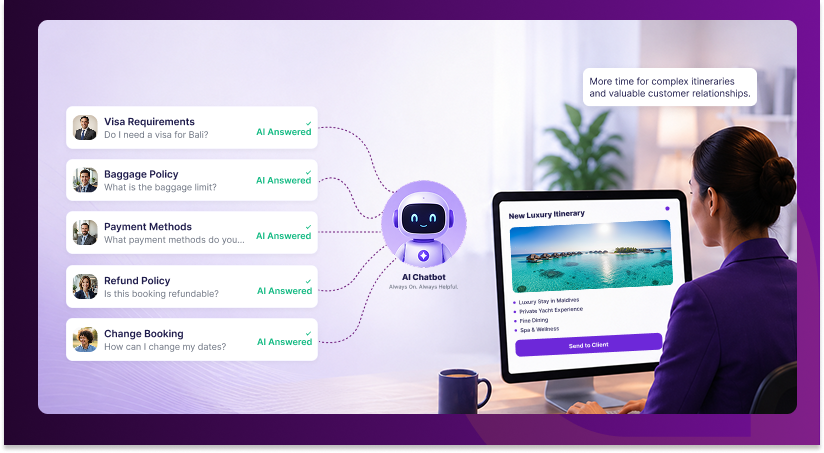
Every agency has the same, recurring questions that come in again and again: baggage rules, visa requirements, cancellation and refund policies, how payments can be made, what seat choice options are available, and how to change an itinerary. Rather than have your highly skilled travel agents spend hours on the phone or sending emails answering these questions repeatedly, those same agents could be developing new packages, upselling more valuable itineraries, or addressing more complex client concerns.

The cost of answering these questions is not only the time lost, but the missed opportunity to build a relationship. Your agent’s time, and the opportunity to help clients discover richer travel experiences that would benefit from thoughtful guidance, are lost each time they repeat an explanation of how to cancel a booking.


3. Multi-Channel Communication Chaos

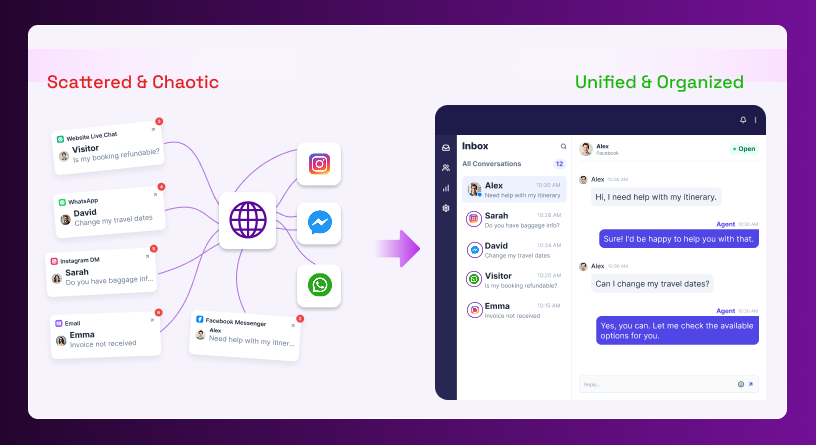
Today’s travelers communicate across a variety of platforms- websites, apps, email, chat on WhatsApp or via SMS, and social media messages. A single customer can start a discussion in an Instagram DM, switch to WhatsApp to ask further questions, and then call the main office if they don’t receive a timely reply. If you don’t have a system in place to keep up with all these communications, agents may ask customers the same questions repeatedly, the context gets lost between channels, and customers become increasingly frustrated.

Fragmented conversations make it harder for managers to oversee service quality, or identify trends that indicate areas for improvement. When communications exist in separate inboxes, it is nearly impossible to build a searchable historical record of customer interactions.


4. Booking Abandonment Due to Hesitation

A travel booking represents a substantial commitment. Between decisions about dates, travel insurance, upgrades, meal options and cancellation policies, there are many points where customers may hesitate. If they have a question as they’re ready to click the “buy” button (“Will this booking be fully refundable?” “Does this package include the train tickets?”) and can’t get an answer in a matter of minutes, there’s a good chance they’ll close the window rather than waiting for a reply from customer service that may arrive hours later.

This hesitation-induced abandonment is a major source of lost revenue in travel, as the client was ready to convert and only needed a bit of reassurance at the critical moment.


5. Handling Sensitive, Time-Critical Situations

Flight delays or cancellations, medical emergencies abroad, natural disasters affecting a travel destination, or the loss of travel documents can cause extreme distress. These types of urgent situations demand swift, reassuring, and accurate responses that simply aren’t possible when using slow or restricted customer support methods. If a customer stranded overseas is faced with prolonged hold times, it’s the quickest way to destroy any trust between your brand and that individual (and anyone who learns about their experience from them).

A poor experience during a travel crisis doesn’t just lose you a single client. In the travel industry, where reviews and personal recommendations are so important, the story of how you handled an emergency spreads far and fast.


6. Language and Regional Barriers

Many travel agencies deal with customers who speak a variety of languages and are situated in different time zones and cultures. When the support infrastructure is primarily phone-based, it can be difficult to offer a sufficient level of multilingual support. Customers will not be able to ask questions or get solutions in the language of their preference, leading them to look elsewhere for a provider that offers better communication.


7. Difficulty Scaling Support During Peak Seasons

Holiday seasons, long weekends, and sudden changes in travel warnings all contribute to massive spikes in the volume of customer requests for support. Hiring, training and managing a large number of seasonal phone support agents is costly, time-consuming and is rarely cost-effective for the brief periods when support demand is high. This constant mismatch between staffing levels and customer demand creates a significant operational challenge in the travel industry.

Benefits of live chat for travel agencies


1. Always on real-time assistance

Live chat allows travelers to receive assistance when it’s needed – confirming their refund policy at midnight or re-routing cancelled flight bookings from a airport lounge. With additional support of chatbots for off-hour assistance, travel agencies can deliver valuable support to customers 24/7, without requiring a large night shift staff. In the travel world where any issue can happen anytime, live chat offers seamless and all-day round the clock assistance.


2. Faster booking & fewer abandoned carts

A single message exchange at the time of buying that answer question about prices and availability, could be all that is standing between a completed booking and a cart left abandoned in mid-purchase. With live chat for travel agencies, we fill that void exactly at the moment travelers are ready to make that commitment and avoid letting a sale pass you by. Since the chat interaction happens live and remains on the same window as the website the traveler is exploring, they won’t need to jump out to get a satisfactory answer.


3. Automation of recurring queries

Chatbots and pre-defined answers deal with questions regarding baggage policies, cancellation policies, document required, payment options, etc., efficiently, accurately and without a hint of a varied tone or a slip up. This gives room to travel agent for focus on complex issues like building itineraries and travel plans, sensitive complaints, and engaging upsell opportunities.
 

4. Seamless customer support across various channels

In modern times, it’s quite common to interact with a customer over social media messengers, WhatsApp, website chat and email, making live chat platform crucial. A unified inbox consolidates conversations from all these platforms and agent can view the conversation thread from the point of first contact irrespective of which channel was used. This saves a customer the frustration of reiterating their concerns and reduces handling time for travel agents.
 

5. Proactive support for travel disruption

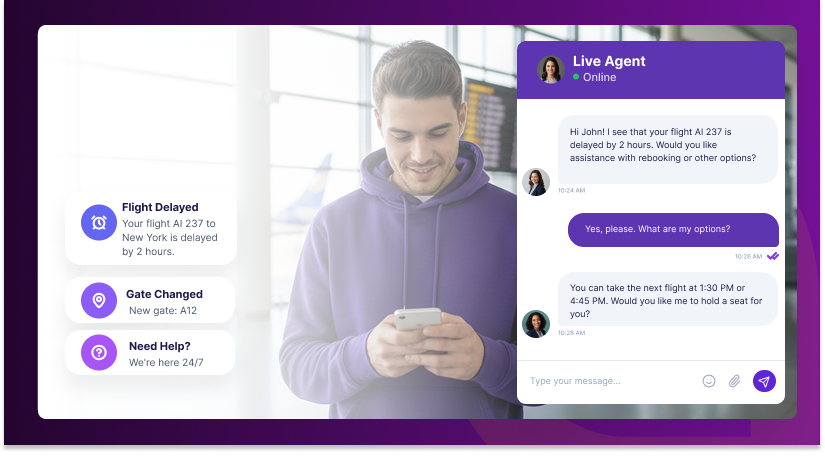
Imagine sending an automatic notification with re-routing options before the passenger realizes his flight has been delayed, rather than making him discover it first and feel the panic. Proactive live chat tools can reach out to travelers right when an issue arise. Turning a challenging scenario into an opportunity to build traveler trust.


6. Multilingual support & global outreach

Provide support to international travelers without hiring native speaking agents on each shift with a live chat solution with translation features or the ability to connect travelers with agents fluent in their language. This expand travel agency’s service reach to include international travelers with the same cost effectiveness.


7. Scalable during travel peak

When travel advisory and public holidays are at their peak, phone support can easily be overwhelmed by volume since one agent can only talk to one traveler at a time. Live chat for travel agencies allows an agent to concurrently handle multiple conversations and this scalability can effectively absorb the increased demand.


8. Customer satisfaction & loyalty increase

Travelers who receive immediate and personalized assistance while making their purchasing decisions or facing travel disruptions are more likely to feel supported and return. This builds brand loyalty, increases retention rates, and encourages word-of-mouth referrals, an essential aspect for businesses in the travel industry.


9. Collect customer insights

Gain valuable insights from your customer conversations through transcripts and analytics. Understand travelers’ pain points, emerging travel trends, frequent complaints, popular destinations and use this data to optimize service delivery, expand content resources, improve marketing strategies, and personalize the overall travel customer experience.


What type of live chat should you choose?

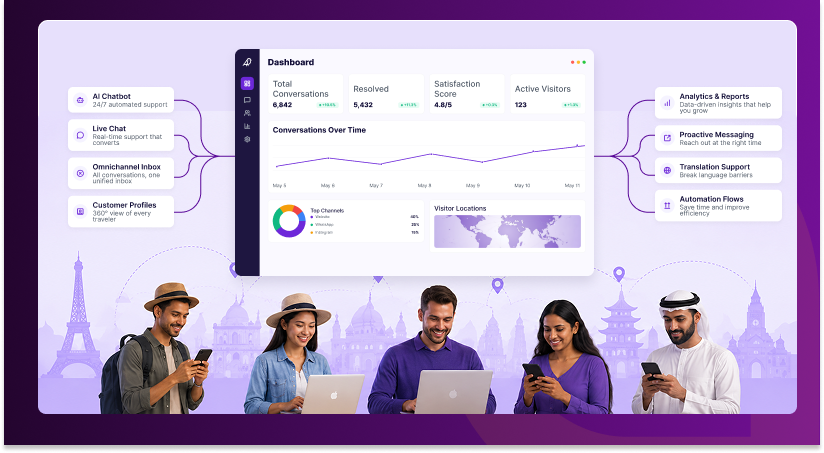
  • The key to effective support in the travel industry lies in using a live chat tool that goes beyond just responding to messages. A good travel-centric live chat solution should:
  • Offer an Omni channel inbox that combines interactions from all communication channels into a single, efficient hub.
  • Include chatbot automation that can instantly handle frequently asked questions, freeing up human agents for more complex tasks.
  • Enable proactive messaging that anticipates customer needs and issues, particularly during travel disruptions.
  • Provide robust analytics and reporting to track performance and identify areas for improvement.
Conclusion

In the travel industry, speed, dependability, and availability are key – qualities that live chat is built to provide. From driving more sales and minimizing booking abandonment to supporting global customers across multiple channels and scale, live chat has evolved into indispensable for delivering excellent travel customer service. The investment in the right live chat platform isn’t merely about quicker responses; it’s about forging enduring customer relationships by offering a consistent, dependable, and superior experience that starts from the initial click, continues throughout the journey, and extends beyond their return.

In a domain where a single positive encounter can lead to loyal customers, and a negative one can lead to a public review, live chat for travel agencies is a critical investment that has a profound impact.

Ready to revolutionize your travel customer support with faster and more intelligent service? Discover Chattrik’s innovative live chat platform designed for the unique demands of the travel business.

From Browser to Buyer: How Live Chat Wins Real Estate Leads at Every Stage

Introduction

Picture this: A prospective homeowner visits your real estate website at 10:47 p.m. They’ve been scrolling through your listings for 40 minutes, saved 3 properties, and they’re just about to ask you a question about one of the properties-something like, “How is the neighborhood?” “What is the parking like?” or “Is the seller willing to negotiate?” They hover over the contact form, start to type, then stop. They don’t want to complete the form and have to wait two days for a response. They want the answer now. So, they close the tab and open up your competitor’s website instead.

This happens tens of thousands of times every day on real estate websites around the world. And the sad part is that this doesn’t have to happen.

The way in which the typical property buyer shops has changed dramatically. They’re highly educated, digitally-savvy, and have little to no patience for delays. They research properties on a multitude of sites, read customer reviews, watch virtual tours, and have come to expect the same instantaneous interaction they receive when using Amazon’s live chat or a Netflix help desk. Traditionally, real estate transactions were completed with phone calls, arranged meetings, and follow-up emails, but this old way of doing business is beginning to lag behind the expectations of today’s consumer. The agencies that are adapting are pulling far ahead of the competition-closing deals faster, getting more qualified leads, and providing drastically higher customer satisfaction ratings.

Live chat-and more importantly, intelligent live chat systems built specifically for real-time customer interaction like Chattrik-is the driving force behind much of this change. In this blog, we’re going to walk you through the complete real estate customer journey, section by section, and show you exactly how live chat is revolutionizing every interaction from the initial website visit all the way to the final handshake at closing.

Understanding the Modern Real Estate Buyer’s Journey

Before we dive into how live chat works in real estate, it’s important to understand the typical decision-making process a modern property buyer goes through. Unlike a decade ago, when buyers largely relied on real estate agents to surface properties, a contemporary buyer will do 80 to 90% of their research entirely online before ever speaking to a real human.

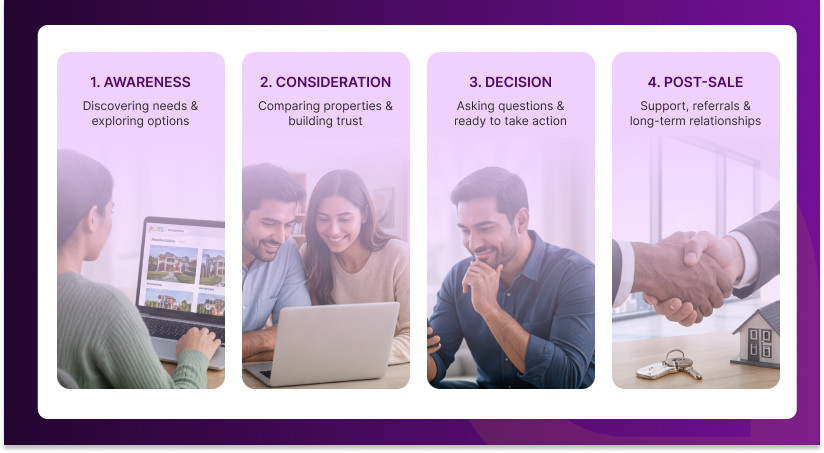
Generally, a typical buyer’s journey appears somewhat like this:

Awareness: The buyer realizes that they need or want to move and will begin a broad search, for instance, by looking for “2-bedroom apartments in Karachi,” “best family-friendly neighborhoods in Lahore,” or “commercial space for lease in DHA.” They will eventually land on listing websites, real estate agency pages, and articles.

Consideration: The buyer has narrowed their focus. They’ll visit agency websites directly, compare properties, bookmark favorites, review neighborhood guides, and try to determine which agency they can rely on for such an important decision.

Decision: They’re ready to take action; they want to arrange a viewing, ask detailed questions about a specific property, or get a quote. This is where the critical interaction typically happens, and it’s often where most real estate websites drop the ball completely.

Post-sale: The journey doesn’t end even once the deal has been finalized. Inquiries about property management, potential referrals, and subsequent business all depend on the customer’s experience throughout the purchasing process.

Live chat has the power to impact every stage of this journey, and is particularly significant at the Consideration and Decision stages, the points where leads are most likely to convert but also most likely to be lost due to inadequate response times.

Stage One: Capturing Attention During the Awareness Phase

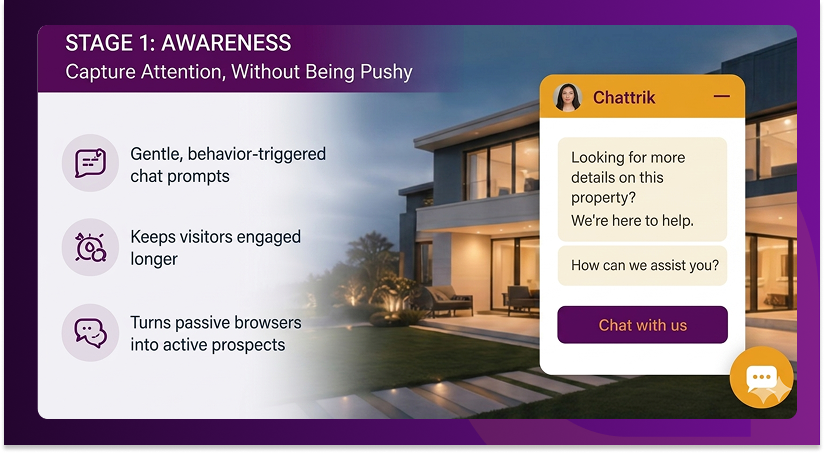
During the awareness stage, the visitor browsing your website is simply in exploration mode and is not ready to make a commitment. The last thing you want to do here is hit them with intrusive pop-ups and requests for their phone number. Instead, make your expertise accessible without being overbearing.

This is where live chat really shines.

A subtly displayed live chat widget-appearing at the bottom corner of the page-communicates a powerful message, that a real human is present and ready to assist at any moment. This transforms your site from a static brochure into an interactive experience. Prospects who see the live chat option will spend longer on your site and explore more properties before ultimately initiating a chat conversation.

Systems such as Chattrik can automate interaction by using triggered chat messages. For instance, if a visitor has spent more than a minute on a particular listing page, a prompt will appear with something like: “Need more details about this property? We’re here to help!” This contextual approach will encourage visitors to contact you because it addresses their current interest.

For real estate agencies, this means you’re no longer solely waiting for leads to arrive. You’re intelligently engaging all those interested prospects who show intent and turning them from passive browsers into engaged leads.

Stage Two: Building Trust During the Consideration Phase

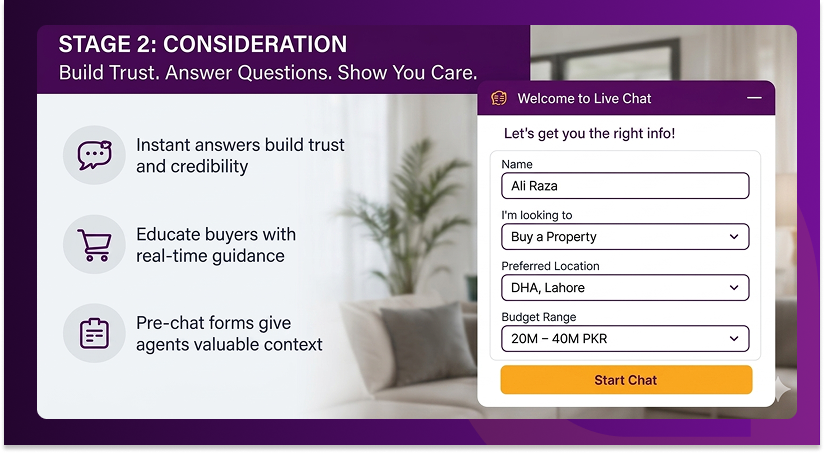
This stage of the real estate sales cycle can lead to a deeper engagement with the prospect, or they might wander away. During this stage, the buyer is researching not just properties, but agencies too. “Can I trust this agency? Will they get back to me quickly? Are they knowledgeable about real estate?”

In real estate, trust is paramount. It’s why 89% of buyers will go with a real estate agent with whom they have previously worked or who was recommended by someone they know. So, how does an agency gain the trust of someone who lands on their site for the first time?

Live chat is one of the most powerful tools an agency can use to build that trust because:
It proves you’re responsive: In an industry where agents are notorious for their slow response times, the ability to provide immediate interaction can be a significant advantage. A prospect who can get a quick response to their question about a listing will instantly know how this agency operates.

It humanizes your brand: Real estate is a very personal undertaking. When buying a home, people are investing significant amounts of money and time. They don’t want to navigate a large corporate site; a human-friendly and helpful live chat interaction makes your agency feel like more than just another company.

It allows you to provide information: The consideration phase is full of questions. What are the market prices in this area? Is this a growing neighborhood or a declining one? What should a first-time homebuyer know about the process? Live chat enables agents to answer all these questions quickly and educate their prospects, positioning them as industry experts rather than mere salespeople.

Chattrik further improves this stage by using a pre-chat form, which allows visitors to enter basic information before the chat begins, such as their name, interest, preferred area, and budget range. This means your agents will know exactly where the buyer is in their purchasing process when the conversation starts, and will be able to offer them a highly personalized interaction.

Stage Three: Converting Intent at the Decision Phase

And here it is: the critical stage. The buyer has done their research and selected some properties to view. They have specific questions and want immediate answers.

For most real estate websites, this is where you lose leads; they only offer a contact form, phone number or email. However, these aren’t suitable for an immediate, serious buyer.

With live chat, this changes.

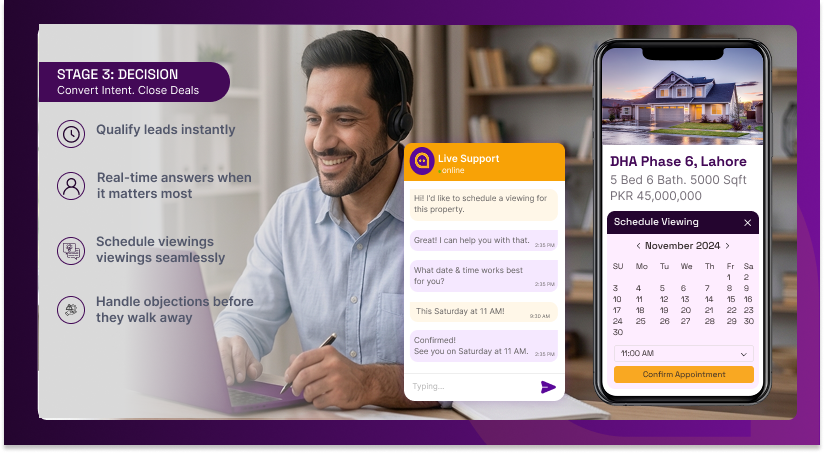
Instant resolution. Buyers who need to confirm the property is still available, inquire about negotiation, or schedule an appointment are only moments away from an answer instead of hours. Every second wasted with a high-intent lead increases your chance of losing that lead to a competitor. Numerous studies show that responding within the first 5 minutes drastically increases your odds of converting that lead compared to an hour later.

On-the-spot lead qualification. Not every visitor who initiates a chat will be a genuine buyer. Chattrik’s platform makes it easy for agents to identify serious buyers by asking targeted questions about budget, timelines, and general seriousness before time and effort are invested. This boosts your team’s efficiency significantly, making your top agents focus on your best prospects.
Seamless booking.

Scheduling an appointment to view a property is notoriously time-consuming and requires back-and-forth emails and phone calls. With live chat, the time to book an appointment can be reduced to a few seconds within a conversation.

Objection handling in real time. Price, location, the state of the property, funding-the list of potential objections goes on and on. For typical responses that come days later via email or a phone call, the emotional aspect has been lost. Live chat keeps this emotional momentum intact by allowing your agent to handle any objections the moment they appear, before doubt can cement into disinterest.

The typing preview feature by Chattrik-showing the agent what the user is typing before it is sent-is a valuable tool in this stage, giving agents time to craft the perfect reply, making the conversation faster and more intelligent.

Stage Four: Retention, Referrals, and Repeat Business

The transaction is done. The keys are in hand. While many agencies see this as the finish line, smart agencies understand that post-sale is where repeat business and referrals are cultivated.

The real estate industry runs on referrals. A satisfied buyer won’t just be a returning customer for their next property purchase; they will refer their friends, family, and business contacts. They will leave reviews. They will become brand advocates. The basis for all of these actions is the entire journey that customer experienced with you.

Live chat is an important post-sale retention tool for several reasons.

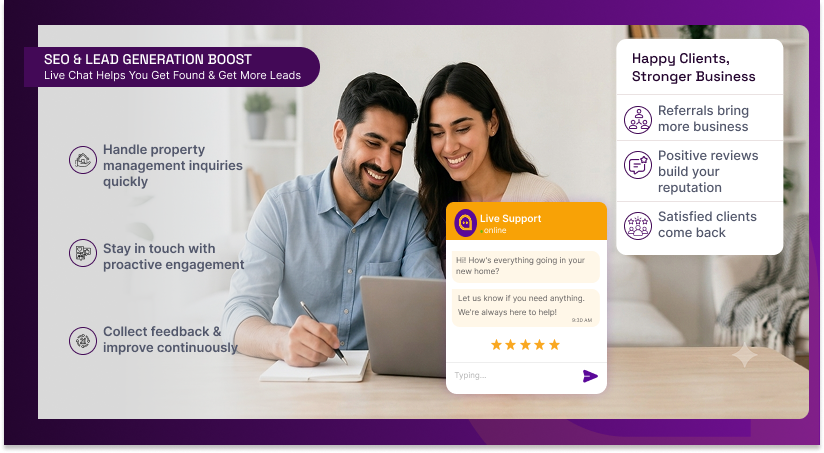
Property management inquiries. In agencies that manage rental properties, commercial spaces, or maintenance schedules, live chat is an efficient way for tenants and owners to relay issues and get answers, rather than going through phone queues or ignored emails.

Ongoing engagement. A proactive follow-up message or a check-in chat after the sale, or mentioning new listings in the vicinity, keeps your customer’s business top of mind. The Chattrik platform helps you manage all customer relationships with one seamless tool, making it more than just a transactional platform.

Feedback collection. With Chattrik’s chat rating function, you collect satisfaction scores after every single interaction, providing real-time data on team performance, customer satisfaction, and areas of concern.

The SEO and Lead Generation Angle: Why Live Chat Also Boosts Your Search Rankings

Perhaps one of the surprising aspects for many real estate professionals when first introduced to live chat is that it doesn’t just convert leads-it actually drives more of them by improving your SEO.

Google measures how engaging a website is by using behavioral signals. One of the most important is how long a user stays on a site (dwell time). Longer dwell time signals that your site is valuable, relevant, and therefore worthy of a higher ranking.

Live chat directly impacts dwell time by increasing the amount of time visitors spend on the page; an engaging chat interaction is more effective at keeping a user focused than static content. As your average website session length increases, so does your search ranking-which means more organic traffic and leads.

Furthermore, your live chat conversations provide extremely valuable content intelligence. The same questions that people ask you through chat are the same questions they type into Google. This allows you to analyze your chat logs and identify common questions like “where should I invest in real estate in Karachi?” “how long does a property transfer take?” or “what documentation is needed to purchase property in Pakistan?” You can then create targeted blog posts, landing pages, and FAQs that answer these exact search queries.

Chattrik’s analytics dashboard offers a straightforward way to track chat volume, visitor behavior, common themes, and agent performance, making your live chat platform a source of ongoing research and content strategy.

Real Estate Use Cases: Chattrik in Action

Let’s put this into concrete terms with a few real-estate specific scenarios where Chattrik’s live chat feature adds value.

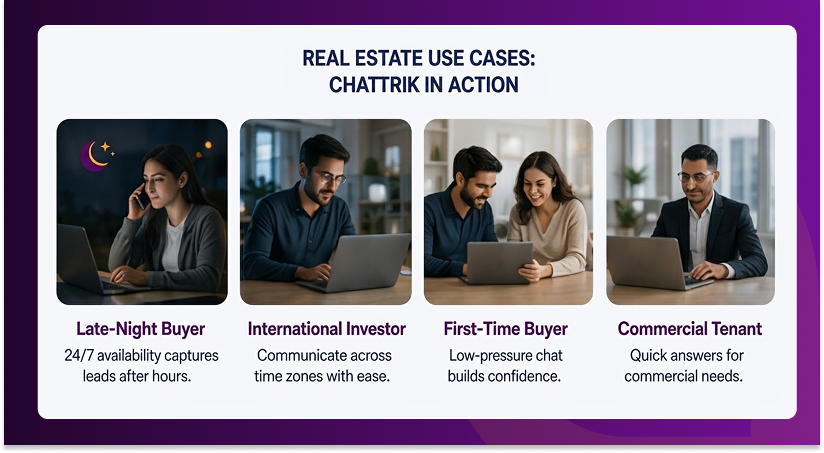
Scenario 1: The Late-Night Buyer A buyer is scrolling through listings late one night. They’ve found the property of their dreams, and want to inquire about the payment terms. Instead of waiting until morning to pick up the phone, they click over to live chat. Configured for 24/7 availability, the automatic response confirms their inquiry and offers basic property details, with an appointment set up for morning. A lead is captured and nurtured, with no agent on call!

Scenario 2: The International Investor An overseas Pakistani investor, based out of Dubai, is keen to explore investment opportunities back in their homeland. Time differences between countries make calling impossible, but through a live chat on your agency’s site, they can communicate with you at their leisure, receive details about rental yields, legal frameworks, and payment schedules, and exchange files and documents, all within the chat.

Scenario 3: The Tentative First-Time Buyer A young couple is trying to navigate the daunting world of first-time buying, and despite their plethora of questions, are afraid to call an agent they’ve never met. A low-pressure live chat provides a safe space for all their queries, and a helpful agent turns a timid browser into a determined buyer!

Scenario 4: The Commercial Tenant A business owner seeking office space is simultaneously comparing several listings. They want immediate answers to questions regarding square footage, lease details, available parking, and potential fit-out contributions. Live chat helps them collect comparative information rapidly, and using Chattrik’s analytics feature, you can see this user has browsed commercial listings four times in a week, indicating high interest, allowing you to prioritize them accordingly.

Why Chattrik Specifically? What Sets It Apart for Real Estate

There are many live chat tools available in the market, but what makes Chattrik the best fit for the real estate industry?

Visitor Behavior Analytics- Real estate purchases are rarely made with a single glance. Clients often revisit a website numerous times, considering different options before making a decision. Chattrik tracks your visitor’s activity through their entire journey, providing your agents with insight into which listings the client viewed, how often, and at which stage they may be in the decision-making process.

Agent Management & Efficiency- Real estate agencies vary dramatically in size, ranging from a one-man operation to a full team of dozens of agents. Chattrik’s management tools empower supervisors to assign chats, observe their team’s progress, check on response times, and ensure that every lead receives attention.

Security & Data Protection- Every transaction in real estate carries a degree of personal and financial sensitivity. Chattrik’s enterprise-grade encryption, along with other robust access controls, ensures that client information is handled in a secure manner, in compliance with all data protection regulations.

Ease of Deployment- Getting started is easy and requires no specialized technical team or a protracted setup period. Simply embed Chattrik into your real estate website and begin capturing leads in as little as a few hours!

Common Objections — And Why They Don’t Hold Up

“We already have a contact form.” A contact form is passive and one-way. Live chat is real-time and interactive. A high-intent lead wanting an answer to a pressing question today simply cannot wait for you to respond to a contact form tomorrow.

“We don’t have the staff to run live chat.” This is the most common fear, and the most obsolete. Chat platforms designed for small business, like Chattrik, offer features like pre-chat forms, automated responses, appointment booking, and variable availability settings, meaning even a 2-person agency can manage their live chat professionally without being overwhelmed.

“Our clients prefer to call.” Some do. Others, such as international clients or younger buyers, strongly favor messaging over calls. Live chat complements, rather than replaces, your phone line, providing a preferred channel for a substantial segment of your audience.

Conclusion: The Real Estate Agency of the Future is Responsive, Real-Time, and Ready

The real estate market is extremely competitive, with thin margins and short attention spans. Agencies with a bigger budget or more listings will not automatically dominate; the real winners are those who provide rapid responses and seamless communication throughout the client journey.

An intelligently implemented live chat feature, using a platform such as Chattrik, represents one of the highest ROI investments you can make. It captures leads you’d otherwise miss, builds trust when it’s most critical, converts high-intent buyers before they contact competitors, and creates the client relationships that result in repeat business and referrals down the line.

The purpose of a real estate agent’s service has always been simple-helping people find a place to call their own. Live chat simply ensures you’re there for them at every stage of the process, from their initial browsing to their final purchase.

If your real estate agency has not yet adopted live chat, the only question you need to ask yourself is: can you afford not to?

Ready to revolutionize your agency’s customer experience? Discover how Chattrik can benefit your team at chattrik.com.