If you’ve ever stood watching a potential customer dwell on your pricing page for 3 minutes, and then vanish with nary a word, you’ll know exactly why live chat software was invented. Not just for talking to visitors; with the right live chat, your website is transformed into an active sales floor, turning conversations into customers and support into a revenue-generating channel.
Two names constantly cited by businesses entering this market: Tawk.to and Chattrik. Superficially, they’re both live chat platforms with widgets, dashboards and agent tools. Digging beneath the surface, however, there are key differences to consider, especially if you’re looking to scale your sales, automate customer engagement and drive growth for your business, particularly in challenging markets like Pakistan or South Asia.
In this post, we compare Tawk.to and Chattrik on every feature, from pricing to automation, analytics, sales features, team management and the types of businesses they are designed for. By the time you’re done, you’ll know exactly which solution fits best for your website.
Introduction
It’s been over 10 years since Tawk.to launched, growing to become what is arguably the most used live chat software in the world. With over 550,000 live websites worldwide (data via BuiltWith), and taking more than 20% market share, their success lies in a very simple formula: the core software is completely free, forever. Unlimited agents. Unlimited chats. Unlimited websites. It’s a truly impressive proposition that has made Tawk.to the go-to solution for countless startups and small businesses.
Chattrik is younger, sleeker and bears significance of a different kind. As Pakistan’s first native AI-enabled live chat software developed by Astrik, a local digital company, Chattrik was launched in early 2026 with the goal of providing Pakistani and regional businesses a powerful and intelligent chat solution, specifically designed for their market rather than a western product adaptation. The company positions Chattrik not simply as a chat platform, but a ‘growth engine’ aimed at building trust, offering instant support, and converting website visitors into lifelong customers.
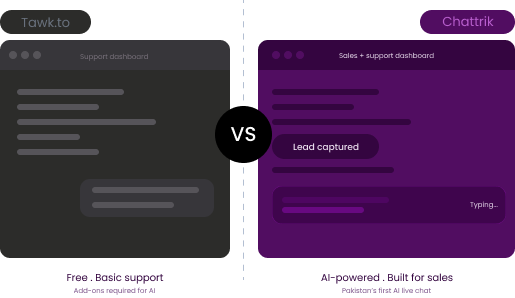
The real question is not which one is free; it’s which one will help your business grow.
Round 1: Core Live Chat Features
Both platforms offer fundamental live chat features, including real-time chat, visitor monitoring, offline messaging and chat transcripts. However, the user experience, depth, and quality differ quite a bit.
Tawk.to
The core Tawk.to feature set is generous. You get a customizable chat widget, pre-written responses, visitor monitoring, file sharing, multi-language support, a built-in ticketing system and knowledge base for free. The platform is available across browsers and mobile apps, and multiple agents can be assigned to conversations simultaneously. Access to chat history is unlimited, and you can monitor visitors and what pages they are on in real time, how long they have been there, and their path on the site.
Users love that they can initiate proactively with visitors, although in Tawk.to it is a manual process, and pre-written messages speed up common interactions for agents managing simultaneous chats. The mobile app works, but users have complained of occasional lag, and it tends to kick agents out at random times, especially on Android.
Chattrik
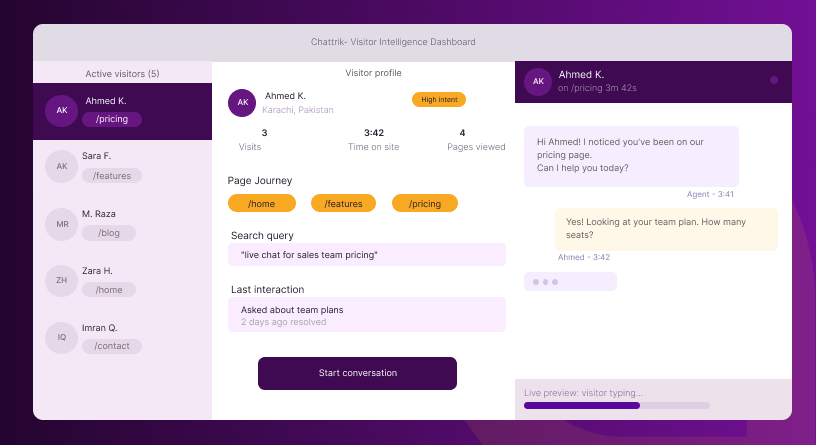
The principle behind Chattrik’s real-time chat is simple: Every conversation is a business opportunity. The real-time visitor monitoring is more than just displaying that a visitor is present-it includes what they are viewing, their search behavior in your knowledge base, and what their recent actions have been. This allows the agent to begin any conversation with essential context about the visitor’s intentions.
One stand-out feature is Chattrik’s sophisticated pre-chat forms. Visitors will fill out key information that gets assigned to the appropriate agent. Not only does this correctly route visitors to their intended destination and qualifies them as leads, it also gives the agent full context from the first moment of the conversation. The company has reported a 48% improvement in first response accuracy and 30-45% decrease in response time for businesses that have started using their forms.
Chattrik’s live typing preview is another useful element. Agents can see what the visitor has typed even before they’ve submitted it. This seems like a minor convenience, but in an actual sales call, it can empower your agents to anticipate needs and have relevant information ready before the visitor finishes typing, resulting in an almost instant response time.
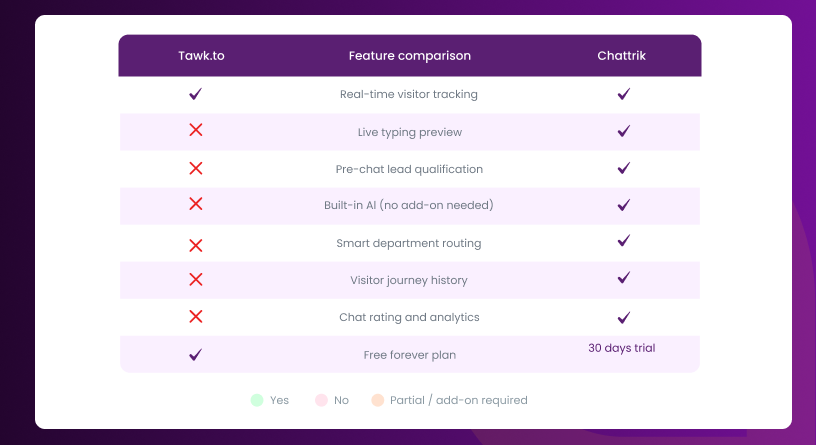
Winner: Chattrik – The deeper visitor context, lead qualification forms and live typing preview give it the upper hand for active sales teams.
Round 2: Pricing — Free vs. Structured Value
Here’s where the two platforms really differentiate themselves.
Tawk.to Pricing
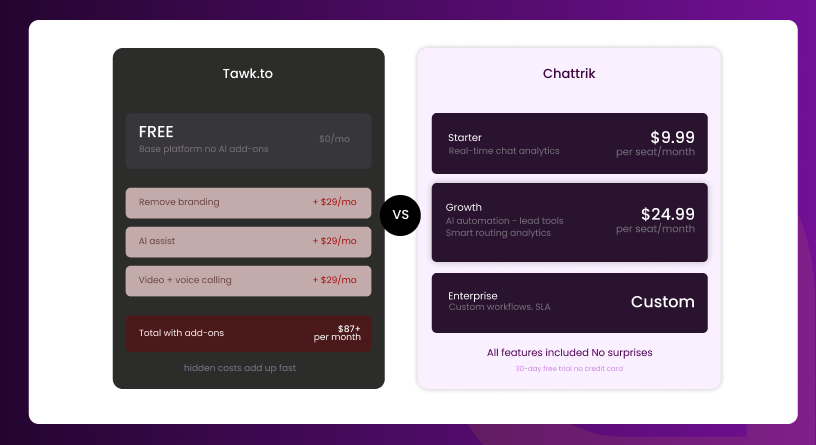
Tawk.to is fundamentally free, with a very comprehensive feature set for free users. It offers unlimited agents, unlimited chats and unlimited websites for $0. The way the company makes money is through optional add-ons:
Remove Branding: $29 per month-this removes the “Powered by tawk.to” branding from the widget and enables white-labeled domains for emails, widgets, and knowledge bases.
AI Assist: starts at $29 per month-this feature enables automated chat, agent reply suggestions, multilingual automation and knowledge base integration. The free plan gives you a very limited 100 AI message credits a month.
Video + Voice + Screensharing: $29 per month-this enables browser based calls and screensharing from within the widget.
Hired Agents: starts at $1 per hour-you can pay Tawk.to to provide you with live agents who answer customer queries in real time. A 24/7 package costs roughly $728 per month.
This model is a truly amazing value for businesses on a zero budget or sole proprietors, as they can get up and running professionally without a single penny. The drawbacks appear when scaling-add-ons are charged per property, which means if you run two sites, your $29 fee is doubled to $58.
Chattrik Pricing Model
Chattrik has a seat-based pricing plan, broken down into three straightforward tiers:
Starter: $9.99 per seat per month (or $14.99 per month when billed monthly)-for startups and small businesses new to live chat.
Growth: $24.99 per seat per month (or $39.99 per month when billed monthly)-for growing businesses that need more control and flexibility.
Enterprise: Custom pricing-for large companies and complex workflows.
A free trial is available (no credit card required), and you can get a feel of the full software before making a commitment. There are no hidden setup fees, and plans can be changed or cancelled anytime.
The core benefit of Chattrik’s pricing plan is transparency and value. For a team of five, you can expect to pay $50-$125 a month for a fully featured, AI-driven chat tool. This is more than competitive, especially when considering the built-in value you receive.
Winner: Tawk.to for the initial zero-budget start; Chattrik for overall value at scale. If you’re looking for a predictable and all-in-one chat solution for a business on the rise, Chattrik’s tiered pricing offers superior value.
Round 3: Automation and AI
This is where the serious contenders truly distinguish themselves from more basic chat solutions. Being able to proactively engage visitors, route chats intelligently, and provide support outside of business hours are no longer nice-to-haves, they are expectations.
Tawk.to’s Automation
Tawk.to provides simple to mid-level automation functionality. With this platform, you can set up automated responses that are triggered by visitor behavior such as how long they’ve spent on a page, the specific URL they are viewing, or even their geographic location. These are especially valuable for reaching out to visitors who seem to be having trouble navigating the site or are on highly focused pages such as pricing or contact us.
The AI Assist add-on elevates this functionality to a much higher level, allowing for 24/7 automated responses, real-time reply suggestions to agents, knowledge base searches, and even multilingual support. The biggest catch is that this is an add-on, and on the free tier, you’re capped at only 100 credits per month; if your business gets more than minimal traffic, this will be eaten up quickly. To run a competent automated chat on Tawk.to, you’ll likely be paying at least $29/month on top of other features for AI Assist.
The AI it offers has been rated as good for boosting agent productivity, rather than capable of having complex, fully autonomous conversations. AI assistance over AI-driven conversation is the description used, and while this works well for efficiency gains it has limited power.
Chattrik’s Automation
From the very beginning of its conception, AI has been at the heart of Chattrik. Unlike platforms where AI was added on as an afterthought, Chattrik’s human-centric approach is designed to feel natural to the user, rather than automated and script-driven. In a client-facing interaction, a touch of natural empathy is paramount in closing sales.
Chattrik’s automation includes:
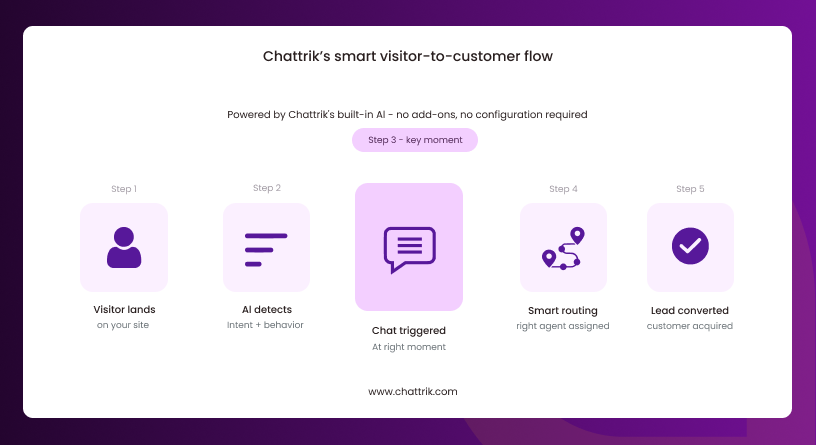
- Smart routing sends chats to the appropriate team member, whether by viewing visitor behavior, page interactions, or data from pre-chat forms. This removes a huge source of customer frustration that stems from having to deal with different departments.
- Proactive triggers engage visitors at the perfect moment by observing visitor behavior.
- Automated conversation flows ensure visitors aren’t shown a standard offline message when visiting after hours; instead they can be helped to generate a lead through the help of conversational automated systems that gather information for the agent.
- Live typing indicators offer a preview of incoming messages so agents have more time to formulate appropriate responses.
Chattrik’s ease of use means you don’t need to train it industry-specifically for effective use; it works right out of the box.
Winner: Chattrik. AI features are an inherent part of the platform, not an additional expense, and the automation focuses on the entire user journey, not isolated interactions.
Round 4: Sales Tools and Lead Generation
While those focused primarily on support will find this section less relevant, anyone interested in growing their revenue through live chat should pay close attention, as this is where a tool really shines.
Tawk.to for Sales
Tawk.to has the basic tools you need for sales including live visitor monitoring, pro-active chat, quick replies to common sales-related questions, and offline forms to ensure no leads are lost during unavailable times. The ticketing system helps manage responses so nothing falls through the cracks.
That said, Tawk.to was built primarily as a support tool that happens to be good enough to be used for sales, rather than a purpose-built sales tool. Lead scoring and pipeline tracking are non-existent, and any integrations with CRMs are via third parties. It’s very common to read reviews on Capterra and GetApp complaining about lack of robust CRM and/or ERP sync, with the user base being forced to create custom lead tracking systems.
The Hired Agents feature sets Tawk.to apart in a number of ways. For $1/hour you can have professionally trained, native English speaking agents man your chat window for you when you or your employees can’t. If you need live coverage but don’t want to or can’t hire staff, this is a huge asset.
Chattrik for Sales
Chattrik was designed from the ground up as a sales conversion tool. Every feature and aspect of the platform revolves around the core principle of turning every chat conversation into an opportunity. Chattrik provides:
- Lead capture and qualification using visitor data and AI to actively monitor behavior and collect lead data intelligently.
- A comprehensive view of the visitor journey so that even if a chat begins coldly, the agent is equipped with extensive background information about the visitor and their browsing history.
- Pre-chat forms that capture essential lead data and reduce the time it takes for agents to provide meaningful support or information. It’s common to report upwards of 40% increase in qualified leads when using forms.
- Department routing which intelligently routes chats based on topic and agent expertise.
- Chat ratings to provide teams with performance metrics on specific agents and interactions, helping you iterate on the most successful communication strategies.
Winner: Chattrik is built with sales conversion at its core, not added on as a secondary function.
Round 5: Analytics and Reporting
Being able to understand your live chat performance and effectively implement improvements is what separates an okay support tool from a great one. Data can help you move from guesswork to strategic decision making.
Tawk.to Analytics
Tawk.to’s analytical tools provide real-time data on your active visitors, volume of chats, response times, and basic performance reports for your agents. There is also the ability to access historical data in order to track trends, as well as a decent overview on the dashboard of how your support agents are performing.
While sufficient for small businesses, this data is limited. It does not allow you to connect chat conversations to your actual sales figures or conversions, as deeper analysis requires third-party integrations.
Chattrik Analytics
Chattrik’s analytical suite is built around your business goals rather than simply how much time is being spent on chat. The platform offers:
- Detailed reports on page performance showing where the most chat engagement is occurring and where visitors are leaving without interaction.
- Individual agent performance reports that include response times, completion rates, and overall customer satisfaction ratings. This is a useful tool for managers to track top performers, identify struggles, and optimize individual coaching.
- Visitor behavior data gives you a CRM-like snapshot by displaying where visitors are spending time and what information they are looking for on your website.
- Customer satisfaction scores which you can track over time and discover which conversations are yielding the best results and where escalations tend to occur.
- Data from the reports has shown a 42% decrease in repeated service issues by identifying trends and a 33% decrease in escalations through improved agent coaching.Winner: Chattrik focuses its analytics on business impact, not just basic tracking metrics.
Round 6: Team Management and Collaboration
When managing a number of agents, shifts, and departments, the backend experience is just as important as the frontend experience.
Tawk.to Team Tools
Unlimited agents (even on the free plan) can be one of Tawk.to’s strongest advantages. Businesses are also given the ability to create various departments, assign agents to their relevant department, and then direct chat conversations based on them. Agents can see chats of their co-workers, and supervisors are given visibility into active chats.
There is a business hours configuration function to have the widget go offline after hours and display an offline form. This is standard functionality but fairly basic.
Chattrik Team Tools
Chattrik has robust team management features for accountability and efficiency.
- Roles allow access to what users need. Agents have specific rights, and then supervisors and admins are granted additional access to specific things.
- There are specific shift management features for businesses, allowing them to manage agent shifts and operating hours with detailed controls.
- The platform permits collaboration between agents on the same conversation; full conversation history means that no customer context is lost.
- Trusted Domains feature means that the chat widget can only be embedded on allowed sites, useful for any businesses white-labelling their chat.
Winner: Tawk.to for its free, unlimited agents; Chattrik for a truly structured team management and accountability framework.
Round 7: Setup, Ease of Use, and Support
The best software for you to choose is the software that you will actually use.
Tawk.to
The ease of setup in Tawk.to cannot be understated; all you have to do to set the widget live on your website is insert a snippet of JavaScript, and this already integrates natively with hundreds of platforms including: WordPress, Joomla, Magento, Shopify and many others. The dashboard of Tawk.to is somewhat dated in appearance but it is a well-functional platform.
Tawk.to offers its 24/7 live support by chat and email, an unusual for a completely free service. There is a comprehensive Help Center and a large enough user base to usually find answers on community forums.
Basic use of the platform has a very low learning curve, however its advanced features such as automating rules or setting up the knowledge base requires more attention and effort, especially on complex scenarios and security which might not be as easy on the more advanced features as some other paid-for products may allow.
Chattrik
Chattrik runs fully within your browser, meaning there is no installation necessary. Setup is reported by users to be remarkably fast with multiple teams getting set up on the day they subscribe. Its dashboard is modern and aims to minimize configuration as much as possible, allowing the business owner to input rules, assign agents to conversations, and set operating hours only once.
A plug and play system for a feature-rich automation set is a huge benefit that Chattrik can offer because it allows for immediate use, without needing to train a bot or set up complicated decision trees to trigger automation, allowing intelligence to be built-in from day one. Customers confirm that the setup is “fast and easy” and the workflow fits naturally into the business’s current operations.
The local team and local support in Pakistan makes Chattrik an even stronger choice; the global nature of a product such as Tawk.to is simply no match compared to a software that has the local experience and understanding needed for success within the Pakistani business ecosystem. If a problem arises, the Chattrik team are on hand.
Winner: Tie. Tawk.to wins for its multitude of integrations and support community, while Chattrik wins for its up to date modern interface and local appeal.
The Bigger Picture: Who Is Each Platform Built For?
After putting both platforms under scrutiny on every metric discussed, it becomes clear who they cater to best.
Tawk.to is ideal for:
- Solofounders and micro-businesses with zero budget
- Any business whose support volume is minimal and sales automation is not the first priority
- Companies whose intention is to have unlimited agents without having to subscribe
- Any company which wants the unique features of a paid plan without paying at all, for instance hired human agents or video calling
- High website count businesses where being able to use an all-access plan across many sites for free is more valuable than any extra bells and whistles
Chattrik is ideal for:
- Pakistani and South Asian businesses who are looking for a locally created software which is relevant to the context in which they operate
- Any business focused on selling which wants the highest conversion rate out of website visitors
- Growing businesses that are looking for a structured plan and cost scaling which allows for budgeting with transparent costings
- Any business that wants to gain a benefit of AI and smart routing without having to purchase a separately sold bot with advanced features and lead capture for an extra fee
- Businesses that care about accountability and data to facilitate growth through insightful data
- Any business looking for a modern, clean and user-friendly tool that is easy to set up and quick to deploy.
Final Verdict: Which platform is the better one to use for sales, automation, and growth?
If your defining metric is budget, then it is clear that Tawk.to is unbeatable. A free, fully-featured live chat software which doesn’t ask for your card details, this truly is a revolutionary deal and for businesses in their earliest stages, beginning the journey of expansion, there isn’t really a better place to start.
However if revenue, growth and efficiency is what you define as your main metric then the situation becomes somewhat different.
Chattrik was built from the beginning on the question of “how to transform each website conversation into a business asset”. It offers a platform which combines superior visitor insights with sophisticated automation, improved lead capture and powerful analytics all in one bundle with pricing which allows growth without unexpected extra charges; it offers value for money and it enables success.
There is also something quite inspiring about the background of Chattrik, being Pakistan’s first locally built, AI-enabled live chat software and providing an unparalleled level of local understanding and accountability that a globally produced product can’t match. It’s an advantage that makes all the difference for businesses in Pakistan who want to outshine their competition and compete at the highest level.
Tawk.to was built on a platform of ‘free’. Chattrik is being built on a platform of ‘better’.
Any business serious about its sales targets, automation and consistent growth should consider Chattrik.
To trial Chattrik for 30 days (with no card required), head over to chattrik.com