
Over the past decade, how you plan trips has changed more dramatically than almost anything else about the way we travel. No one wants to wait days for a callback from their agency, spend an hour searching FAQ pages hoping for a nugget of information in the fine print, or be left hanging on a layover when their flight is canceled and their next step is completely unknown. Whether they’re comparing flights at midnight, trying to confirm that the room they’ve just booked has a view of the ocean, or are stuck on a 6-hour layover, travelers expect instant answers from your travel business.
Nowhere is this expectation more crucial than in travel. When something goes wrong – a booking mistake, a forgotten deadline to cancel, or a delayed response during a travel crisis – it can mean more than lost revenue for your agency. It can mean a ruined vacation, a botched business trip, or the unraveling of a once-in-a-lifetime experience. The way that companies respond when travel hits a bump in the road matters – travelers remember and they tell other travelers through reviews, recommendations and social media.
In this guide we look at some of the biggest pain points that agencies struggle with today, and show how live chat is the most effective tool for solving them, then examine the tangible benefits that come with adding live chat support to your agency.
What Agencies Struggle With
1. Customers Expect Instant Answers, Around the Clock
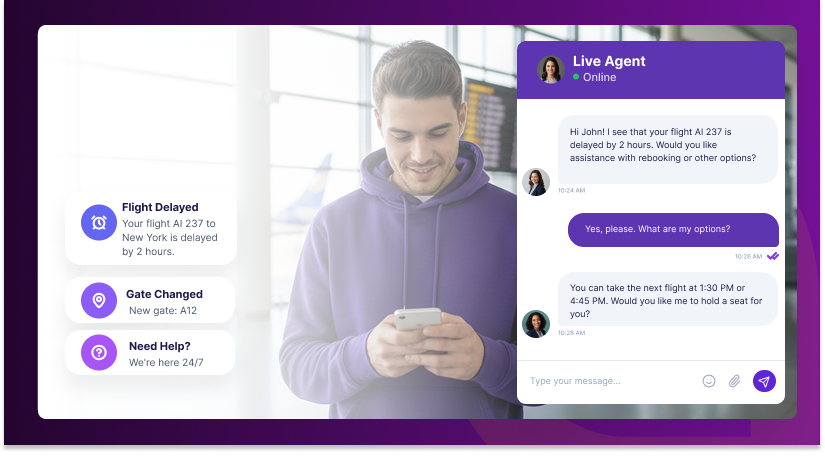
Travel doesn’t run on a 9-to-5 clock, nor do customer questions. Travel delays hit at 3 AM, a quick visa question might pop up over a weekend when no one’s in the office, or a traveler at the airport may have a last-minute itinerary change and limited time to act. The limitations of phone calls (fixed operating hours) and email (daylong delays) mean that even when an agency responds diligently, they often can’t keep up with the unpredictable nature of travel planning and disruptions.
The consequences of falling behind quickly compound: bookings are abandoned mid-way, customers switch to agencies that offer immediate help, and social media fills up with angry reviews that can take years to overcome. Trust is hard to build in the travel industry; when trust erodes due to a lack of immediate assistance during critical moments, it leads to the permanent loss of future business.
2. High Volume of Repetitive Questions
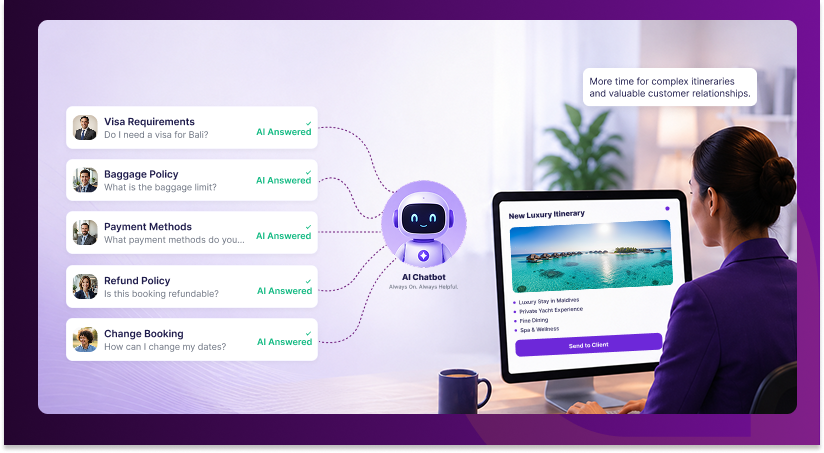
Every agency has the same, recurring questions that come in again and again: baggage rules, visa requirements, cancellation and refund policies, how payments can be made, what seat choice options are available, and how to change an itinerary. Rather than have your highly skilled travel agents spend hours on the phone or sending emails answering these questions repeatedly, those same agents could be developing new packages, upselling more valuable itineraries, or addressing more complex client concerns.
The cost of answering these questions is not only the time lost, but the missed opportunity to build a relationship. Your agent’s time, and the opportunity to help clients discover richer travel experiences that would benefit from thoughtful guidance, are lost each time they repeat an explanation of how to cancel a booking.
3. Multi-Channel Communication Chaos
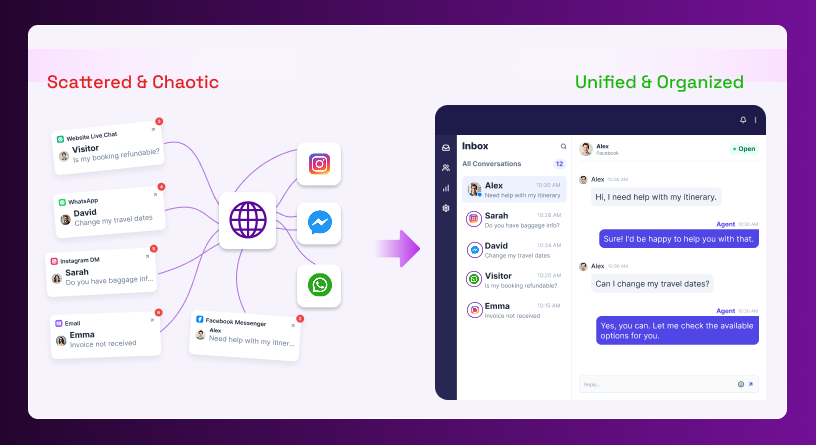
Today’s travelers communicate across a variety of platforms- websites, apps, email, chat on WhatsApp or via SMS, and social media messages. A single customer can start a discussion in an Instagram DM, switch to WhatsApp to ask further questions, and then call the main office if they don’t receive a timely reply. If you don’t have a system in place to keep up with all these communications, agents may ask customers the same questions repeatedly, the context gets lost between channels, and customers become increasingly frustrated.
Fragmented conversations make it harder for managers to oversee service quality, or identify trends that indicate areas for improvement. When communications exist in separate inboxes, it is nearly impossible to build a searchable historical record of customer interactions.
4. Booking Abandonment Due to Hesitation
A travel booking represents a substantial commitment. Between decisions about dates, travel insurance, upgrades, meal options and cancellation policies, there are many points where customers may hesitate. If they have a question as they’re ready to click the “buy” button (“Will this booking be fully refundable?” “Does this package include the train tickets?”) and can’t get an answer in a matter of minutes, there’s a good chance they’ll close the window rather than waiting for a reply from customer service that may arrive hours later.
This hesitation-induced abandonment is a major source of lost revenue in travel, as the client was ready to convert and only needed a bit of reassurance at the critical moment.
5. Handling Sensitive, Time-Critical Situations
Flight delays or cancellations, medical emergencies abroad, natural disasters affecting a travel destination, or the loss of travel documents can cause extreme distress. These types of urgent situations demand swift, reassuring, and accurate responses that simply aren’t possible when using slow or restricted customer support methods. If a customer stranded overseas is faced with prolonged hold times, it’s the quickest way to destroy any trust between your brand and that individual (and anyone who learns about their experience from them).
A poor experience during a travel crisis doesn’t just lose you a single client. In the travel industry, where reviews and personal recommendations are so important, the story of how you handled an emergency spreads far and fast.
6. Language and Regional Barriers
Many travel agencies deal with customers who speak a variety of languages and are situated in different time zones and cultures. When the support infrastructure is primarily phone-based, it can be difficult to offer a sufficient level of multilingual support. Customers will not be able to ask questions or get solutions in the language of their preference, leading them to look elsewhere for a provider that offers better communication.
7. Difficulty Scaling Support During Peak Seasons
Holiday seasons, long weekends, and sudden changes in travel warnings all contribute to massive spikes in the volume of customer requests for support. Hiring, training and managing a large number of seasonal phone support agents is costly, time-consuming and is rarely cost-effective for the brief periods when support demand is high. This constant mismatch between staffing levels and customer demand creates a significant operational challenge in the travel industry.
Benefits of live chat for travel agencies
1. Always on real-time assistance
Live chat allows travelers to receive assistance when it’s needed – confirming their refund policy at midnight or re-routing cancelled flight bookings from a airport lounge. With additional support of chatbots for off-hour assistance, travel agencies can deliver valuable support to customers 24/7, without requiring a large night shift staff. In the travel world where any issue can happen anytime, live chat offers seamless and all-day round the clock assistance.
2. Faster booking & fewer abandoned carts
A single message exchange at the time of buying that answer question about prices and availability, could be all that is standing between a completed booking and a cart left abandoned in mid-purchase. With live chat for travel agencies, we fill that void exactly at the moment travelers are ready to make that commitment and avoid letting a sale pass you by. Since the chat interaction happens live and remains on the same window as the website the traveler is exploring, they won’t need to jump out to get a satisfactory answer.
3. Automation of recurring queries
Chatbots and pre-defined answers deal with questions regarding baggage policies, cancellation policies, document required, payment options, etc., efficiently, accurately and without a hint of a varied tone or a slip up. This gives room to travel agent for focus on complex issues like building itineraries and travel plans, sensitive complaints, and engaging upsell opportunities.
4. Seamless customer support across various channels
In modern times, it’s quite common to interact with a customer over social media messengers, WhatsApp, website chat and email, making live chat platform crucial. A unified inbox consolidates conversations from all these platforms and agent can view the conversation thread from the point of first contact irrespective of which channel was used. This saves a customer the frustration of reiterating their concerns and reduces handling time for travel agents.
5. Proactive support for travel disruption
Imagine sending an automatic notification with re-routing options before the passenger realizes his flight has been delayed, rather than making him discover it first and feel the panic. Proactive live chat tools can reach out to travelers right when an issue arise. Turning a challenging scenario into an opportunity to build traveler trust.
6. Multilingual support & global outreach
Provide support to international travelers without hiring native speaking agents on each shift with a live chat solution with translation features or the ability to connect travelers with agents fluent in their language. This expand travel agency’s service reach to include international travelers with the same cost effectiveness.
7. Scalable during travel peak
When travel advisory and public holidays are at their peak, phone support can easily be overwhelmed by volume since one agent can only talk to one traveler at a time. Live chat for travel agencies allows an agent to concurrently handle multiple conversations and this scalability can effectively absorb the increased demand.
8. Customer satisfaction & loyalty increase
Travelers who receive immediate and personalized assistance while making their purchasing decisions or facing travel disruptions are more likely to feel supported and return. This builds brand loyalty, increases retention rates, and encourages word-of-mouth referrals, an essential aspect for businesses in the travel industry.
9. Collect customer insights
Gain valuable insights from your customer conversations through transcripts and analytics. Understand travelers’ pain points, emerging travel trends, frequent complaints, popular destinations and use this data to optimize service delivery, expand content resources, improve marketing strategies, and personalize the overall travel customer experience.
What type of live chat should you choose?
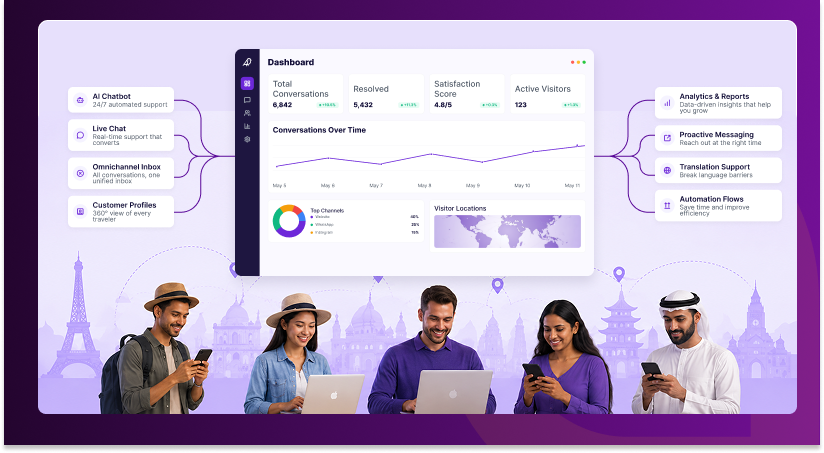
- The key to effective support in the travel industry lies in using a live chat tool that goes beyond just responding to messages. A good travel-centric live chat solution should:
- Offer an Omni channel inbox that combines interactions from all communication channels into a single, efficient hub.
- Include chatbot automation that can instantly handle frequently asked questions, freeing up human agents for more complex tasks.
- Enable proactive messaging that anticipates customer needs and issues, particularly during travel disruptions.
- Provide robust analytics and reporting to track performance and identify areas for improvement.
Conclusion
In the travel industry, speed, dependability, and availability are key – qualities that live chat is built to provide. From driving more sales and minimizing booking abandonment to supporting global customers across multiple channels and scale, live chat has evolved into indispensable for delivering excellent travel customer service. The investment in the right live chat platform isn’t merely about quicker responses; it’s about forging enduring customer relationships by offering a consistent, dependable, and superior experience that starts from the initial click, continues throughout the journey, and extends beyond their return.
In a domain where a single positive encounter can lead to loyal customers, and a negative one can lead to a public review, live chat for travel agencies is a critical investment that has a profound impact.
Ready to revolutionize your travel customer support with faster and more intelligent service? Discover Chattrik’s innovative live chat platform designed for the unique demands of the travel business.