How Visitor Monitoring Helps Your Sales Team

Your sales team spends hours chasing leads that go cold and guessing which prospects are actually ready to talk. Meanwhile, someone is on your pricing page right now, comparing plans, reading your FAQ, and deciding whether to reach out, and your team has no idea this is happening.

This is the gap that visitor monitoring closes. Instead of reacting to form submissions days after a prospect’s real interest has cooled off, your sales team can see what’s happening on your website as it happens, and act while that interest is still fresh and top of mind for the visitor.

In this post, we’ll walk through what visitor monitoring actually does, the core features that make it useful in practice, the real, measurable benefits it brings to sales teams, and a few practical examples of how it plays out in day-to-day selling situations.

What Is Visitor Monitoring?


Visitor monitoring is the practice of tracking who is on your website, what pages they’re viewing, how long they stay on each one, and what actions they take, all in real time, as the visit is happening rather than after the fact. Paired with website visitor tracking tools, it turns anonymous web traffic into visible, actionable data that your sales team can actually use to prioritize their day.

Instead of a lead only existing after they fill out a contact form, visitor monitoring lets you see interest building well before that point: repeat visits over several days, meaningful time spent on key decision-stage pages, and the specific questions a prospect seems to be trying to answer through their browsing behavior.

Without this visibility, sales teams are essentially working blind. They wait for someone to raise their hand through a form, a demo request, or a chat message, and by the time that happens, they’ve already missed the window where the visitor was actively comparing options and forming an opinion about your product.


Features That Power Visitor Monitoring


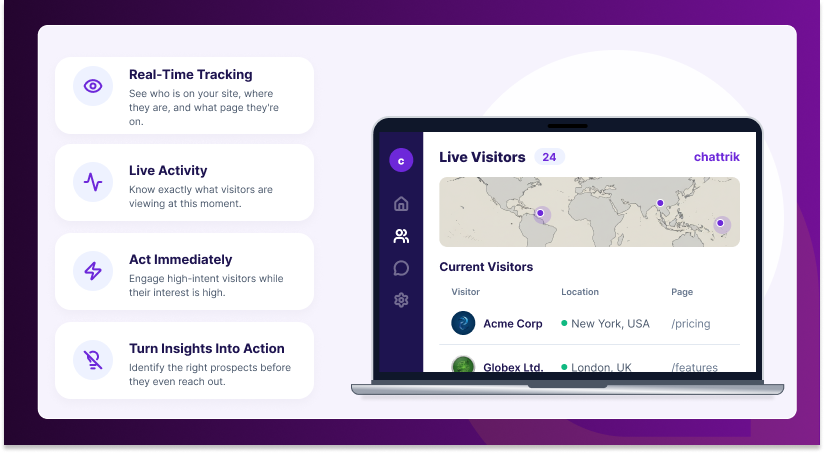
Real-Time Visitor Tracking

At its core, visitor monitoring shows you who’s on your site right now, their approximate location, the device and browser they’re using, and the page they landed on. For sales teams, this means no more waiting for a lead to “surface” through a form days or weeks later. You see the activity as it happens, which opens the door to timely, well-placed outreach.

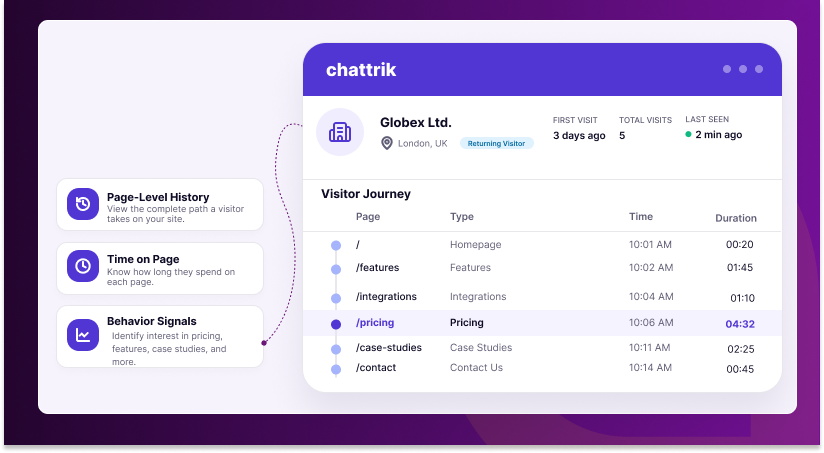
Page-Level Activity History

Good visitor monitoring doesn’t stop at simply knowing someone is on the site. It logs the full path a visitor takes: which pages they viewed, in what order, and how long they spent on each one before moving on. A visitor who lands on your homepage, browses your features page, then spends four minutes on pricing is telling you something very different than someone who bounces off the homepage after five seconds. That difference in behavior is exactly what sales teams need to prioritize their time well.

Visitor Identification and Enrichment

Modern platforms can match anonymous traffic to company names, industries, and sometimes individual contacts using IP data and firmographic enrichment. This turns a vague “visitor from an unknown location” into “someone from a mid-sized logistics company just viewed your enterprise plan twice this week.” That level of detail makes it far easier to decide who’s worth a personal outreach and who can wait.

Returning Visitor Alerts

Visitor monitoring tools can flag when someone who’s visited before comes back to the site. Returning visitors are often further along in their decision-making process than first-time visitors, and a second or third visit within a short window is a strong buying signal that your sales team really shouldn’t miss, especially if it lines up with an open deal or a recent conversation.

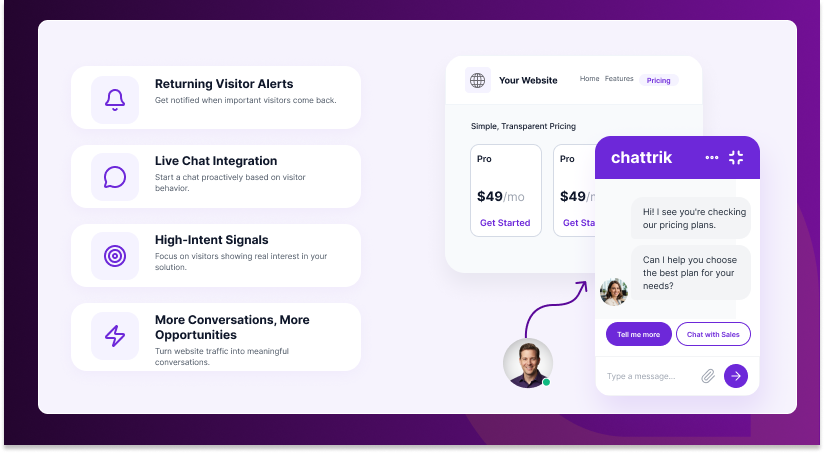
Integration With Live Chat

When visitor monitoring is connected to live chat, your team can proactively start a conversation with a high-intent visitor instead of waiting for them to reach out first. Seeing that someone has been sitting on your pricing page for several minutes is the perfect trigger to open a chat window and offer help before they lose momentum or leave to compare a competitor.

Lead Scoring Based on Behavior

Some platforms let you assign scores to specific behaviors: visiting a pricing page, viewing a demo request page, downloading a resource, or returning multiple times in a week. This gives your sales team a simple, consistent way to prioritize who to contact first, based on actual observed behavior rather than gut feeling or the order leads happened to come in.

Custom Alerts and Notifications

Beyond dashboards, most visitor monitoring platforms let you set up alerts so reps are notified the moment a target account or high-value visitor lands on the site. This means a rep doesn’t have to be watching a dashboard all day. Instead, the system pushes the signal to them directly, through email, Slack, or an in-app notification, right when it matters.

The Benefits for Your Sales Team


Faster, Better-Timed Outreach

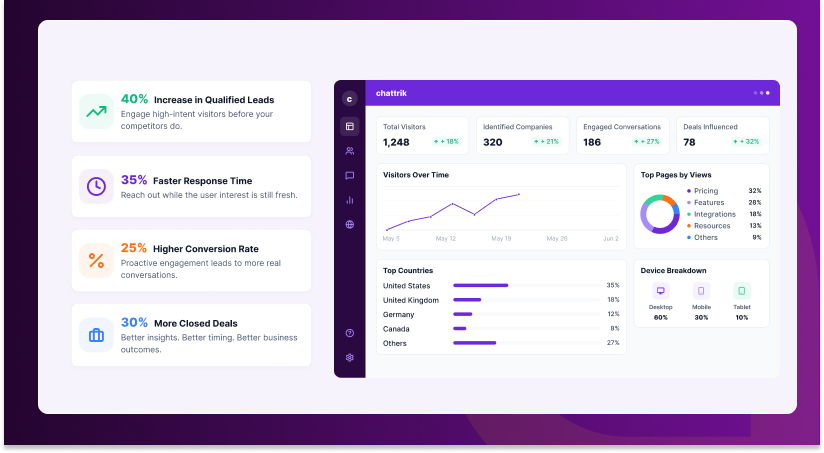
The biggest advantage of visitor monitoring is timing. Sales teams no longer have to wait for a form fill or a scheduled follow-up call that might land days after the prospect’s interest has already cooled. They can reach out, or start a chat, while the visitor is actively engaged and the interest is at its peak, which dramatically increases the odds of a meaningful response.

Sharper Lead Prioritization

Not every visitor is ready to buy, and not every lead deserves the same amount of attention right away. With visitor monitoring, reps can see who’s browsed multiple pages, returned more than once, or spent real time on decision-stage content like pricing or case studies, and focus their limited time and energy there first instead of spreading it evenly across every lead in the queue.

More Informed Conversations

Instead of opening a call with generic discovery questions, reps walk in already knowing what a prospect has looked at and, often, what they seem to care about most. A conversation that starts with “I noticed you were comparing our plans” builds trust faster and moves the conversation along more efficiently than a cold, unguided pitch that has to start from zero.

Shorter Sales Cycles

When reps engage at the right moment with the right context, deals tend to move faster from first contact to close. Visitor monitoring removes a lot of the early back-and-forth typically needed to figure out what a prospect cares about, since much of that information is already visible before the first real conversation even starts.

Better Alignment Between Marketing and Sales

Visitor monitoring also gives sales visibility into which marketing pages and campaigns are actually driving engaged, high-intent traffic, not just raw visit numbers. This makes it easier for both teams to agree on what’s working, put more resources behind the content and campaigns that are actually influencing deals, and stop guessing at attribution.

Fewer Missed Opportunities

Without visitor monitoring, high-intent visitors can slip away completely unnoticed, simply because they didn’t happen to fill out a form before leaving. With it, your team can catch and engage these visitors in the moment, before they leave the site and go compare a competitor’s offering instead.

More Efficient Use of Sales Headcount

For smaller sales teams especially, visitor monitoring acts as a force multiplier. Instead of hiring more reps to cover more outbound volume, existing reps can spend their time on the visitors who are already showing intent, which tends to produce a better return per rep hour than blind cold outreach.


Visitor Monitoring in Action: Real Examples


Example 1: Catching a Warm Lead Before They Leave

A visitor from a mid-sized manufacturing company lands on your homepage, browses your features page, then spends over three minutes on your pricing page. Visitor monitoring flags this activity to your sales team in real time. A rep opens a live chat: “Hi, I noticed you were checking out our plans, happy to answer any questions.” The visitor, who was about to leave and think it over on their own, instead gets a demo booked on the spot before they lose momentum.

Example 2: Prioritizing a Returning Visitor

A prospect visited your site two weeks ago, spent a few minutes on your integrations page, and left without converting or leaving any contact details. They come back today and go straight to your pricing page. Visitor monitoring flags them as a returning, high-intent visitor based on that pattern. Instead of sitting in a generic follow-up queue behind dozens of colder leads, they’re bumped to the top of the sales team’s outreach list for that day.

Example 3: Using Behavior to Personalize a Sales Call

A rep is about to call a lead who filled out a demo request form earlier in the week. Before the call, they check the visitor’s activity history and see the lead spent time specifically on the security and compliance page, not the general features page. The rep opens the call by addressing security directly, instead of running through a generic pitch, and the conversation moves straight to the prospect’s actual concerns rather than wasting time on things they already understand.

Example 4: Spotting Account-Level Interest

Visitor monitoring shows that three different visitors from the same company have viewed your site over the past week, one on the features page, one on pricing, and one on the FAQ page. This pattern suggests a buying committee is doing research together rather than a single person browsing casually. Sales can now approach this account as a coordinated opportunity, looping in the right stakeholders early, rather than treating each visit as a separate, unrelated lead.

Example 5: Re-Engaging a Stalled Deal

An open opportunity has gone quiet for two weeks, with no replies to follow-up emails. Visitor monitoring shows that the main contact quietly returned to the pricing page twice in the last few days, without reaching out. This tells the rep the deal isn’t dead, it’s just stalled, and gives them a natural, well-timed reason to follow up again with something more specific than a generic “just checking in” message.

Bringing It All Together

Visitor monitoring turns your website from a passive brochure into an active source of sales intelligence. By combining real-time tracking, page-level activity history, visitor identification, returning visitor alerts, and live chat integration, your sales team gets the context they need to reach out at the right time, with the right message, to the right people, instead of relying on guesswork and generic outreach cadences.

If your team is still relying on form fills and cold outreach alone, you’re likely missing the visitors who are already showing strong buying signals on your site today. Website visitor tracking closes that gap, giving sales the visibility they need to act before the opportunity quietly walks away to a competitor.

Live Chat for Travel Agencies: A Complete Guide

Over the past decade, how you plan trips has changed more dramatically than almost anything else about the way we travel. No one wants to wait days for a callback from their agency, spend an hour searching FAQ pages hoping for a nugget of information in the fine print, or be left hanging on a layover when their flight is canceled and their next step is completely unknown. Whether they’re comparing flights at midnight, trying to confirm that the room they’ve just booked has a view of the ocean, or are stuck on a 6-hour layover, travelers expect instant answers from your travel business.

Nowhere is this expectation more crucial than in travel. When something goes wrong – a booking mistake, a forgotten deadline to cancel, or a delayed response during a travel crisis – it can mean more than lost revenue for your agency. It can mean a ruined vacation, a botched business trip, or the unraveling of a once-in-a-lifetime experience. The way that companies respond when travel hits a bump in the road matters – travelers remember and they tell other travelers through reviews, recommendations and social media.

In this guide we look at some of the biggest pain points that agencies struggle with today, and show how live chat is the most effective tool for solving them, then examine the tangible benefits that come with adding live chat support to your agency.

What Agencies Struggle With


1. Customers Expect Instant Answers, Around the Clock

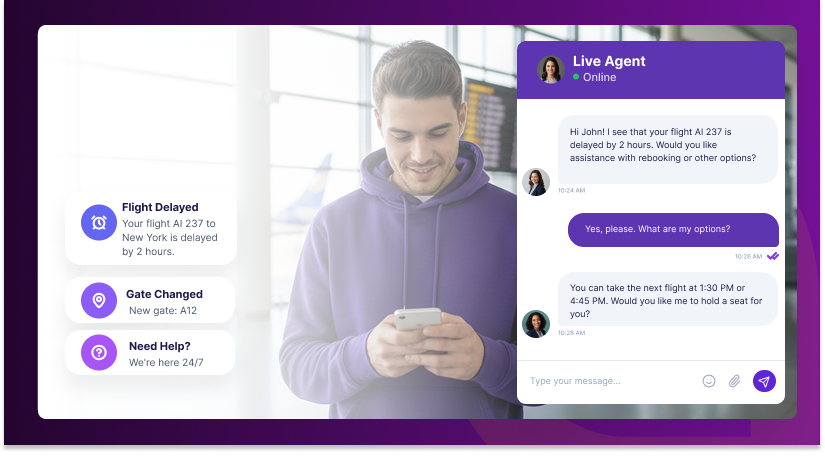
Travel doesn’t run on a 9-to-5 clock, nor do customer questions. Travel delays hit at 3 AM, a quick visa question might pop up over a weekend when no one’s in the office, or a traveler at the airport may have a last-minute itinerary change and limited time to act. The limitations of phone calls (fixed operating hours) and email (daylong delays) mean that even when an agency responds diligently, they often can’t keep up with the unpredictable nature of travel planning and disruptions.

The consequences of falling behind quickly compound: bookings are abandoned mid-way, customers switch to agencies that offer immediate help, and social media fills up with angry reviews that can take years to overcome. Trust is hard to build in the travel industry; when trust erodes due to a lack of immediate assistance during critical moments, it leads to the permanent loss of future business.

2. High Volume of Repetitive Questions

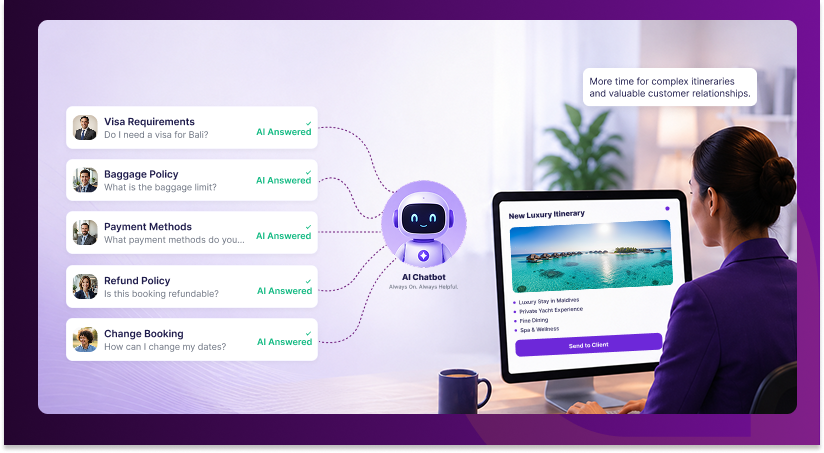
Every agency has the same, recurring questions that come in again and again: baggage rules, visa requirements, cancellation and refund policies, how payments can be made, what seat choice options are available, and how to change an itinerary. Rather than have your highly skilled travel agents spend hours on the phone or sending emails answering these questions repeatedly, those same agents could be developing new packages, upselling more valuable itineraries, or addressing more complex client concerns.

The cost of answering these questions is not only the time lost, but the missed opportunity to build a relationship. Your agent’s time, and the opportunity to help clients discover richer travel experiences that would benefit from thoughtful guidance, are lost each time they repeat an explanation of how to cancel a booking.


3. Multi-Channel Communication Chaos

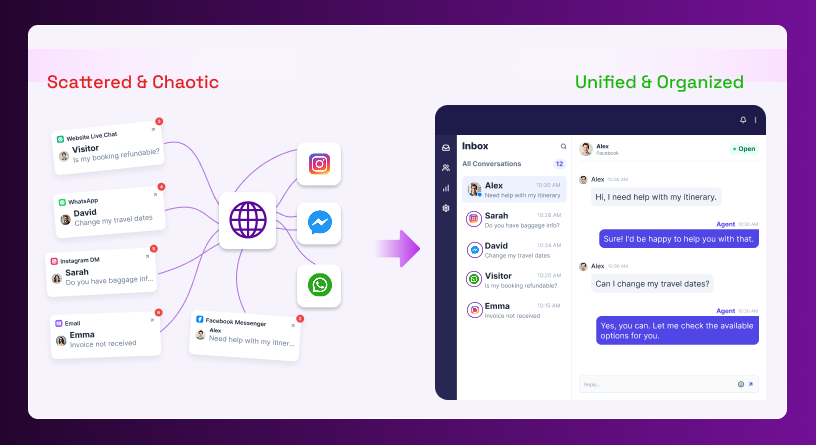
Today’s travelers communicate across a variety of platforms- websites, apps, email, chat on WhatsApp or via SMS, and social media messages. A single customer can start a discussion in an Instagram DM, switch to WhatsApp to ask further questions, and then call the main office if they don’t receive a timely reply. If you don’t have a system in place to keep up with all these communications, agents may ask customers the same questions repeatedly, the context gets lost between channels, and customers become increasingly frustrated.

Fragmented conversations make it harder for managers to oversee service quality, or identify trends that indicate areas for improvement. When communications exist in separate inboxes, it is nearly impossible to build a searchable historical record of customer interactions.


4. Booking Abandonment Due to Hesitation

A travel booking represents a substantial commitment. Between decisions about dates, travel insurance, upgrades, meal options and cancellation policies, there are many points where customers may hesitate. If they have a question as they’re ready to click the “buy” button (“Will this booking be fully refundable?” “Does this package include the train tickets?”) and can’t get an answer in a matter of minutes, there’s a good chance they’ll close the window rather than waiting for a reply from customer service that may arrive hours later.

This hesitation-induced abandonment is a major source of lost revenue in travel, as the client was ready to convert and only needed a bit of reassurance at the critical moment.


5. Handling Sensitive, Time-Critical Situations

Flight delays or cancellations, medical emergencies abroad, natural disasters affecting a travel destination, or the loss of travel documents can cause extreme distress. These types of urgent situations demand swift, reassuring, and accurate responses that simply aren’t possible when using slow or restricted customer support methods. If a customer stranded overseas is faced with prolonged hold times, it’s the quickest way to destroy any trust between your brand and that individual (and anyone who learns about their experience from them).

A poor experience during a travel crisis doesn’t just lose you a single client. In the travel industry, where reviews and personal recommendations are so important, the story of how you handled an emergency spreads far and fast.


6. Language and Regional Barriers

Many travel agencies deal with customers who speak a variety of languages and are situated in different time zones and cultures. When the support infrastructure is primarily phone-based, it can be difficult to offer a sufficient level of multilingual support. Customers will not be able to ask questions or get solutions in the language of their preference, leading them to look elsewhere for a provider that offers better communication.


7. Difficulty Scaling Support During Peak Seasons

Holiday seasons, long weekends, and sudden changes in travel warnings all contribute to massive spikes in the volume of customer requests for support. Hiring, training and managing a large number of seasonal phone support agents is costly, time-consuming and is rarely cost-effective for the brief periods when support demand is high. This constant mismatch between staffing levels and customer demand creates a significant operational challenge in the travel industry.

Benefits of live chat for travel agencies


1. Always on real-time assistance

Live chat allows travelers to receive assistance when it’s needed – confirming their refund policy at midnight or re-routing cancelled flight bookings from a airport lounge. With additional support of chatbots for off-hour assistance, travel agencies can deliver valuable support to customers 24/7, without requiring a large night shift staff. In the travel world where any issue can happen anytime, live chat offers seamless and all-day round the clock assistance.


2. Faster booking & fewer abandoned carts

A single message exchange at the time of buying that answer question about prices and availability, could be all that is standing between a completed booking and a cart left abandoned in mid-purchase. With live chat for travel agencies, we fill that void exactly at the moment travelers are ready to make that commitment and avoid letting a sale pass you by. Since the chat interaction happens live and remains on the same window as the website the traveler is exploring, they won’t need to jump out to get a satisfactory answer.


3. Automation of recurring queries

Chatbots and pre-defined answers deal with questions regarding baggage policies, cancellation policies, document required, payment options, etc., efficiently, accurately and without a hint of a varied tone or a slip up. This gives room to travel agent for focus on complex issues like building itineraries and travel plans, sensitive complaints, and engaging upsell opportunities.


4. Seamless customer support across various channels

In modern times, it’s quite common to interact with a customer over social media messengers, WhatsApp, website chat and email, making live chat platform crucial. A unified inbox consolidates conversations from all these platforms and agent can view the conversation thread from the point of first contact irrespective of which channel was used. This saves a customer the frustration of reiterating their concerns and reduces handling time for travel agents.


5. Proactive support for travel disruption

Imagine sending an automatic notification with re-routing options before the passenger realizes his flight has been delayed, rather than making him discover it first and feel the panic. Proactive live chat tools can reach out to travelers right when an issue arise. Turning a challenging scenario into an opportunity to build traveler trust.


6. Multilingual support & global outreach

Provide support to international travelers without hiring native speaking agents on each shift with a live chat solution with translation features or the ability to connect travelers with agents fluent in their language. This expand travel agency’s service reach to include international travelers with the same cost effectiveness.


7. Scalable during travel peak

When travel advisory and public holidays are at their peak, phone support can easily be overwhelmed by volume since one agent can only talk to one traveler at a time. Live chat for travel agencies allows an agent to concurrently handle multiple conversations and this scalability can effectively absorb the increased demand.


8. Customer satisfaction & loyalty increase

Travelers who receive immediate and personalized assistance while making their purchasing decisions or facing travel disruptions are more likely to feel supported and return. This builds brand loyalty, increases retention rates, and encourages word-of-mouth referrals, an essential aspect for businesses in the travel industry.


9. Collect customer insights

Gain valuable insights from your customer conversations through transcripts and analytics. Understand travelers’ pain points, emerging travel trends, frequent complaints, popular destinations and use this data to optimize service delivery, expand content resources, improve marketing strategies, and personalize the overall travel customer experience.


What type of live chat should you choose?

  • The key to effective support in the travel industry lies in using a live chat tool that goes beyond just responding to messages. A good travel-centric live chat solution should:
  • Offer an Omni channel inbox that combines interactions from all communication channels into a single, efficient hub.
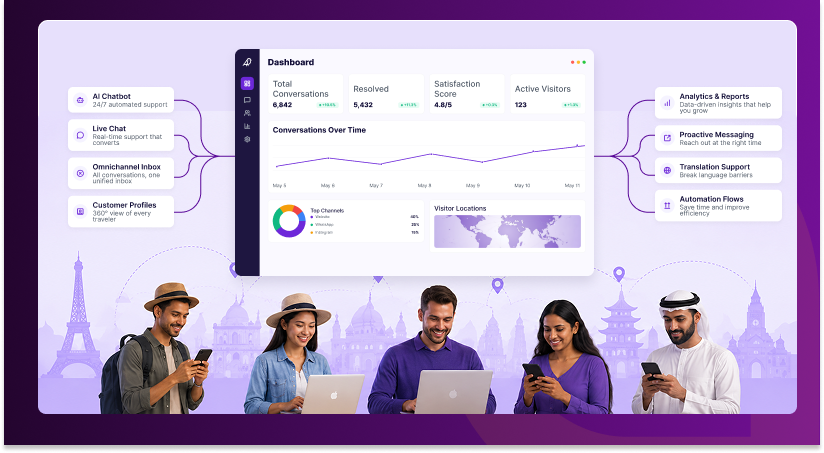
  • Include chatbot automation that can instantly handle frequently asked questions, freeing up human agents for more complex tasks.
  • Enable proactive messaging that anticipates customer needs and issues, particularly during travel disruptions.
  • Provide robust analytics and reporting to track performance and identify areas for improvement.

Conclusion

In the travel industry, speed, dependability, and availability are key – qualities that live chat is built to provide. From driving more sales and minimizing booking abandonment to supporting global customers across multiple channels and scale, live chat has evolved into indispensable for delivering excellent travel customer service. The investment in the right live chat platform isn’t merely about quicker responses; it’s about forging enduring customer relationships by offering a consistent, dependable, and superior experience that starts from the initial click, continues throughout the journey, and extends beyond their return.

In a domain where a single positive encounter can lead to loyal customers, and a negative one can lead to a public review, live chat for travel agencies is a critical investment that has a profound impact.

Ready to revolutionize your travel customer support with faster and more intelligent service? Discover Chattrik’s innovative live chat platform designed for the unique demands of the travel business.

Why Live Chat is the Future of Customer Service in the Middle East

An illustration of a Middle Eastern professional appearing from a smartphone screen next to a chat bubble.
Introduction

In the Middle East, customer expectations are evolving more rapidly than ever before. Consumers, from the UAE and Saudi Arabia to Qatar, Bahrain, Kuwait and Oman, expect speed, convenience and highly personalized digital experiences as a result of the area’s fast-paced digital transformation. From government portals to e-commerce sites, high speed, better accessibility, and effective real-time communications have become indispensable.

In this ever-changing digital environment, live chat has quickly emerged as a game-changing tool and a new supportive tool for better customer service in the Middle East. Companies continue to grapple with rising expectations for instant and reliable support, while live chat provides a culturally appropriate, seamless, and effective communication channel.

Email responses are perceived to take too long, call centers provide long hold times, and WhatsApp support seems to be in high demand but does not provide any structure or continuity. Live chat solves these issues by providing exactly what today’s Middle Eastern consumers desire.

In this blog, we will discuss why live chat is rapidly becoming the preferred avenue of engagement in the region, highlighting the role live chat plays in enhancing the customer experience, promoting operational effectiveness, and maintaining a competitive edge in an ever-changing Middle Eastern landscape.

As firms in the region are implementing intelligent live chat solutions like Chattrik, it’s becoming evident that the future of customer service is fast, conversational, and personalized. Live chat is not only a conversational tool but also the future of customer engagement in the Middle East.

A Glimpse of Customer Experience in the Middle East

The Middle East—especially the GCC—stands out for its young, super-connected population. People here basically live online. In countries like the UAE and Saudi Arabia, internet access is almost universal, and just about everyone has a smartphone glued to their hand. So, it’s not just that folks are connected; they’re always online, shopping, chatting, and sizing up brands based on every little interaction.
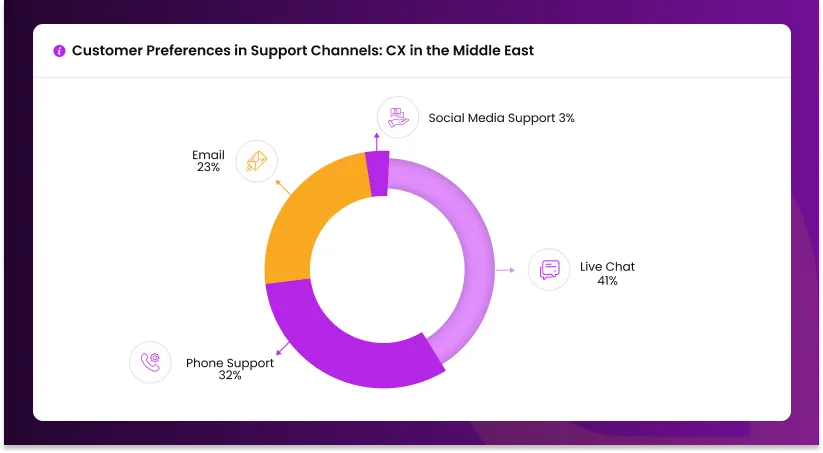
A donut chart titled Customer Preferences in Support Channels showing live chat leading at 41%.

What really shapes what customers want?

A few things come to mind.

First, there’s the mobile-first way of life. Middle Eastern people, like others around the world, have become overly dependent on their mobile phones for all their activities. They handle everything on their phones—shopping, banking, streaming, messaging—you name it. Live chat just fits right in. It’s quick, easy, and works perfectly on mobile. Unlike email or call centers, you don’t have to wait on hold or for someone to reply hours later. You get help right as you’re browsing.

Then, look at how digital services have exploded. There are fintech apps, online stores, healthcare platforms, government sites, travel portals—the list keeps growing. All these need support that can keep up with the tons of users. Live chat delivers that speed and scale.

Culturally, people in the Middle East value fast, respectful, and genuine service. Waiting around for someone to answer? That doesn’t fly. A quick reply goes a long way in building trust.

And honestly, traditional customer service still lags. Lots of brands stick to old-school email or phone support, but today’s digital-savvy customers want something fresher. Live chat fills that gap, offering real conversations in real time.

So, with all this digital maturity, it’s no surprise the Middle East is the perfect place for live chat to thrive.

How Live Chat Is Transforming Customer Service Across the Middle East

Live chat is swiftly becoming the pillar of customer service in the Middle East, ahead of channels often considered to be more traditional, such as email, call centers, and in-store support. As consumers in the UAE, Saudi Arabia, Qatar, Kuwait, Bahrain, and Oman increasingly want instant, mobile-first, and personalized digital exchanges, live chat is considered the best modality to serve the expectations of today’s consumers.

Here are the important reasons live chat is changing customer experience, and growing business in the region:

Timely Engagement for Big Expectations Markets

GCC consumers have grown accustomed to real-time experiences with brands such as Careem, Talabat, and Amazon.ae. Live chat provides immediate engagement without the delays of being on hold or bouncing back and forth in emails, making it the ideal channel for digitally savvy, fast-paced customers.
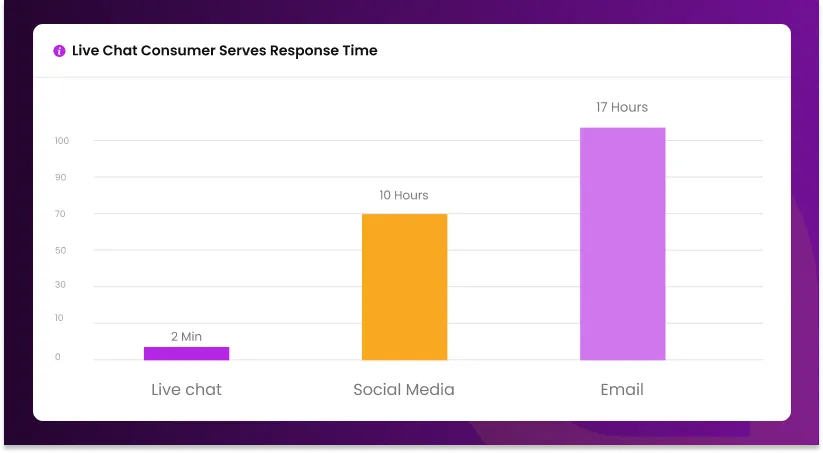
A bar chart titled Live Chat Consumer Serves Response Time comparing response times of chat, social media, and email.

The Way Modern Middle Eastern Consumers Prefer to Communicate

Chat apps continue to dominate all aspects of daily communication, and live chat is an extension of how people communicate naturally. Millennials and Gen Z, which comprise a large segment of the consumers who shop online in the GCC, tend to prefer shorter, conversational support and dislike taking a formal call or writing lengthy emails.

Surveys consistently rank chat apps and SMS as the most requested channels of brand communications in the GCC, further solidifying the relevance of live chat.

24/7 Availability with AI and Automation

Consumers across the Middle East typically don’t turn on their computers to shop; they often shop late at night, and usually on their mobile device. While AI chat functionality is being utilized, some might be on hand 24/7. The live chat customer service is vital in those circumstances so that consumers never feel disengaged and disconnected from brands. Consumers are now accustomed to immediate engagement they choose to initiate a conversation with the brand.
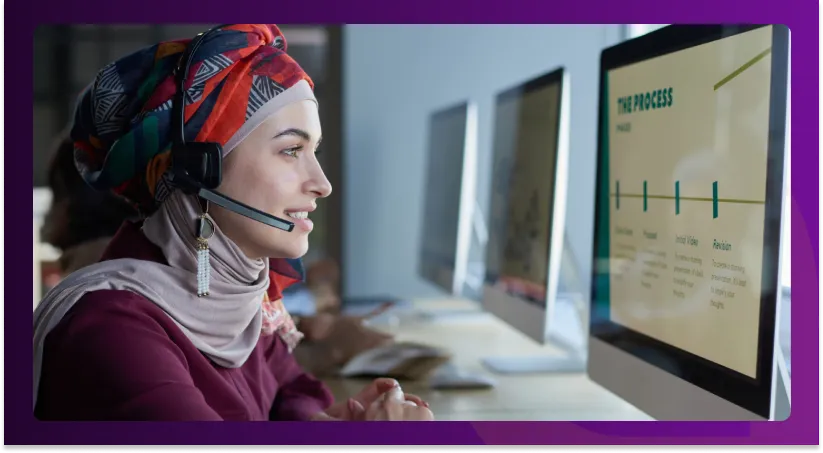
A photograph of a customer service agent wearing a hijab and a headset while looking at a desktop monitor.

Whether it’s 11 PM and a Namshi customer has a question, or a Noon customer has a question about delivery for the game they want to order for their child, the live chat support is immediate and accessible.

Multilingual Support in a Multicultural Area

Since the Middle East is primarily a multicultural region, it has become important for brands to support multiple languages to get the job done. It isn’t uncommon for a consumer shopping online in the GCC to have 2-3 languages stacked on top of each other. Live chat enables brands to connect and support this consumer potential by extending the multi-language assistance to consumers, replacing traditional phone calls or lengthy emails. Live chat enables brands to facilitate, in part, the possible demand languages from Spanish, French, Arabic, and more.
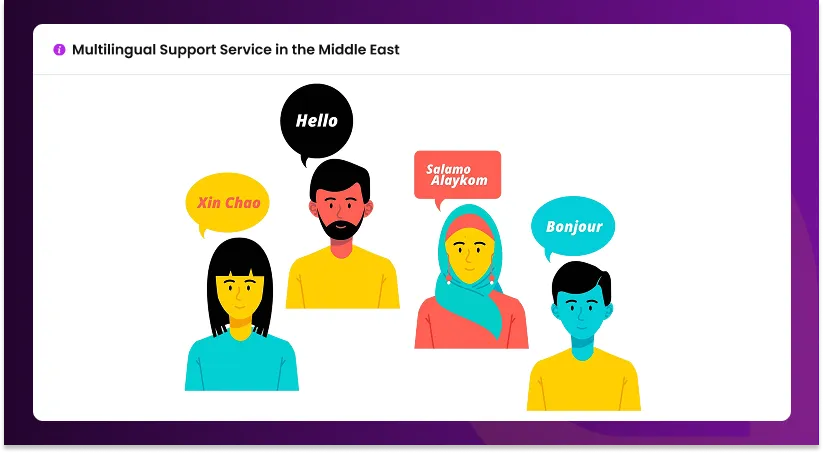
An illustration titled Multilingual Support Service in the Middle East showing diverse customer avatars with multi-language greetings.

AI chatbots can even adapt to different Arabic dialects across:

  • UAE
  • Saudi Arabia
  • Kuwait
  • Qatar
  • Bahrain
  • Oman

This multilingual flexibility gives live chat a clear advantage over other channels.

Customized and Context-Responsive Experiences for Customers

Live chat allows for customized, context-responsive experience for customers by analyzing their browsing behavior, past interactions, and customer profiles to provide tailored responses. For example, Majid Al Futtaim’s e-commerce brands utilize chat assistance to provide customized product recommendations, stock availability updates, and real-time offers based on the browsing path each user has taken. Platforms like Chattrik also enhance this service by allowing agents to view a user’s live session, enabling them to provide exact, relevant, contextual support, resulting in significantly increased customer satisfaction and loyalty.
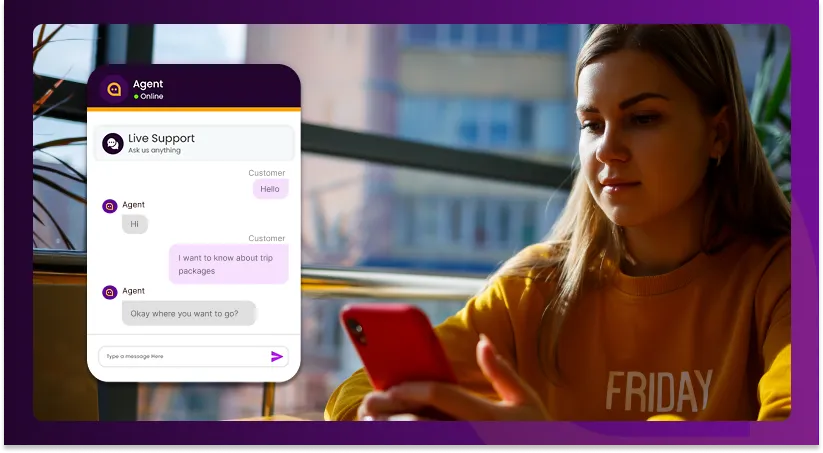
A woman using her smartphone to chat with an online live support travel agent.

Significant Cost Savings for Businesses

Live chat provides significant cost savings by enabling a single agent to assist multiple conversations at once. Resultantly, it helps reduce the strength of customer support teams. Furthermore, automated features, such as answering FAQs, ticket generation, and appointment scheduling, reduce operating costs and support increased efficiency. This applies especially to Small and Medium-sized Enterprises (SMEs) in cities such as Dubai, Riyadh, Jeddah, Doha, and Manama, wanting to provide affordable quality support for their customers.

Higher Conversion Rates and Less Cart Abandonment

Live chat leads directly to sales by enabling customers to get instant answers to their questions during the buying process. For example, if a customer does not know when delivery will occur, they can get an immediate answer and complete their purchase. Similarly, if a shopper doesn’t know if a certain item is compatible with a certain product, they can receive quick guidance and then add the item to their shopping cart. Across the Middle East, e-commerce businesses have recorded higher conversion rates and much less cart abandonment when live chat is part of their websites.
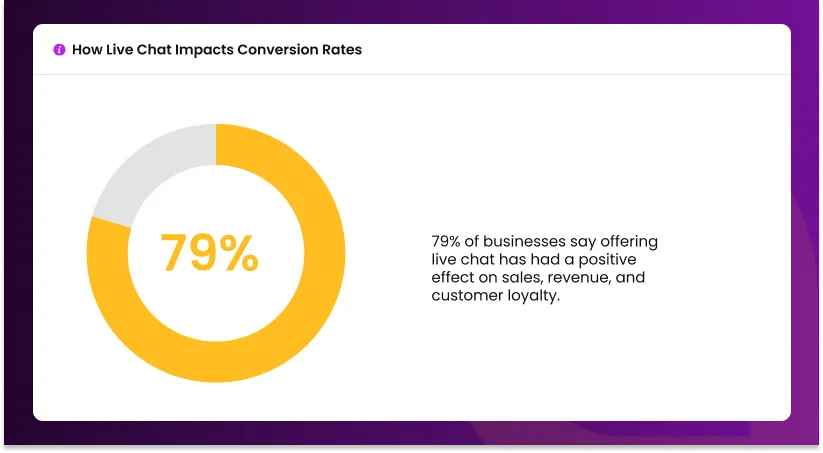
A data graphic titled How Live Chat Impacts Conversion Rates showing that 79% of businesses report a positive effect.

Better Customer Experience (CX)

Live chat creates a frictionless customer experience by providing instant replies, precise, easy-to-understand guidance communicated through multiple devices. Customers can ask a question, browse a product, and complete their purchase, all without having to switch applications or wait on hold, ultimately leading to a much more seamless and satisfying customer journey.
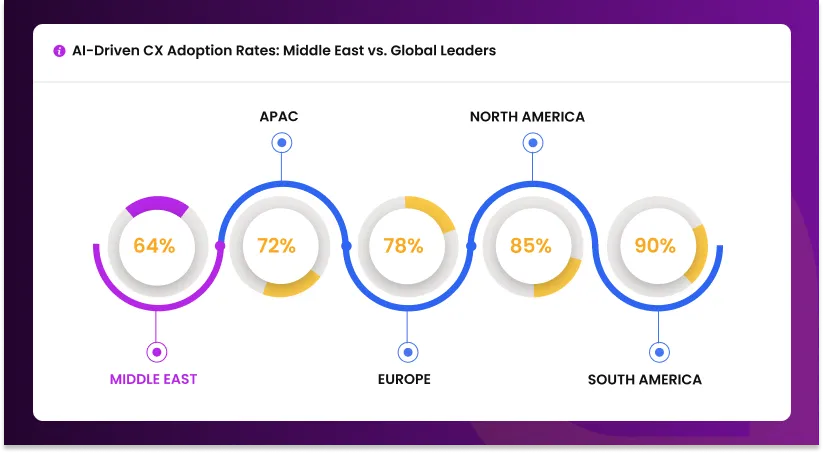
A timeline graphic comparing AI-Driven CX Adoption Rates between the Middle East at 64% and global leaders.

Omnichannel Support That Brings Customers Closer

Live chat integrates with WhatsApp, social media, mobile apps, and SMS, which allows businesses to create a continuous, consistent support experience across all channels. This omnichannel support brings customers closer to the brand as it continues their chat in the same way and builds trust in the overall experience with your business.

Real-Time, Reliable, and Reassuring Support

Offering live chat signals openness, accessibility, and brand reliability. Customers feel reassured knowing they can reach support instantly whenever needed—building long-term trust and loyalty.

Live Chat Adoption Trends in the Middle East

Fueled by government vision, consumer expectations, and technological innovation, live chat adoption is picking up speed across all sectors. Among the best adoption trends include:

National Initiatives for Digital Transformation

Countries like Saudi Arabia and the United Arab Emirates are giving top-notch digital services top priority through projects including:

  • UAE Digital Administration Policy
  • Saudi Vision 2030
  • Qatar Smart Program (TASMU)

These systems urge public and private organizations to upgrade their communication systems including live chat. Many government sites already offer live chat help. For instance, Dubai’s Smart Government portal gives real-time chat to help citizens navigate things like visa applications, licencing, and payments.

E-Commerce and Online Retail Growth

Platforms like Amazon.ae, Noon, Carrefour Online, and Namshi have popularized fast digital customer service. Live chat supports their high volumes of returns, delivery updates, and product inquiries.

With more Middle Eastern consumers shopping online, businesses of all sizes—from boutique stores to enterprise retailers—need chat-based support to stay competitive.

Banking & Fintech Leadership

Banks like Emirates NBD, Qatar National Bank, Al Rajhi Bank, and Abu Dhabi Islamic Bank have integrated chat support for account inquiries, card activations, loan assistance, and more.

Fintech apps such as stc pay, Tabby, and Tamara use live chat and AI chatbots to provide instant financial support.

Travel, Tourism & Hospitality

Airlines like Emirates, Qatar Airways, Etihad Airways, and major hotel chains now rely on live chat to handle booking issues, flight changes, check-in support, and customer queries.

The tourism-heavy economies of Dubai, Doha, and Riyadh increasingly prefer multilingual chat support for visitors.

SMEs Embracing Live Chat to Compete

Small and medium-sized businesses—especially online stores—are rapidly adopting live chat through platforms like Chattrik to provide customer service without the need for large call centers.

The Role of AI and Automation in Enhancing Live Chat in the Middle East

The Middle East is a center for customer support that utilizes AI. Businesses have to deliver a fast-accurate-multilingual service, so businesses rely on advanced technologies of AI to strengthen their live chat.

AI-enabled chatbots, in particular those that are based on platforms like Chattrik, manage basic service questions such as order tracking, delivery confirmation, verifying ownership of accounts, resetting passwords, and frequently asked questions. This alleviates the burden of service teams and gives the option for customer service 24/7 if needed. For instance, major telecom companies like du (UAE) and STC (Saudi Arabia) have automated chat systems to help customers diversify their experiences, especially during peak demand for questions regarding bills, data packages, and troubleshooting.

Smart routing, which is in addition to everything already mentioned, is when the chatbot can recognize what type of question the customer has and route the conversation to a human agent. This is more favorable for the customer because they do not need to wait in a long line, knowing they have an agent who can help them. AI can also assess the sentiment of the customer i.e. frustration or urgency–and escalate the conversation if needed.

In addition, predictive AI offers organizations the ability to identify customer needs. If the user is tracking a delivery six times, for example, the system may automatically initiate a chat to provide updated time-of-delivery estimates. Using a proactive approach to customer care can dramatically improve customer satisfaction, and it aligns with the kind of service experience consumers in the Middle East expect in this day and age. The combination of live chat plus AI is not replacing an organization’s human agent workforce; it is making them more productive. With AI performing repetitive tasks, human agents are now responsible for complicated customer issues that require empathy and judgment. This hybrid approach to customer service is rapidly becoming the new standard for excellent customer service in the Middle East.

Industries Leading Live Chat Adoption in the Middle East

E-Commerce & Retail

The growth of e-commerce in the Middle East has experienced tremendous growth, with the UAE and Saudi Arabia emerging as the leaders in regional spending. Established firms like Amazon.ae, Noon, Carrefour, and Namshi have developed dynamic chat-based ways to service consumer questions related to anything related to returns or delivery, as well as product-based questions.

Conversely, smaller online retailers also experience the benefits of live interaction, specifically with building trust – something less necessary in markets where consumers are apprehensive about purchasing from unfamiliar brands. Receiving on-the-spot answers during the checkout process will boost conversion and decrease cart abandonment.

Banking & Fintech

Banks and financial institutions throughout the region are integrating live engagement technology to replace long wait times associated with call center queues. With banks like Emirates NBD, Al Rajhi Bank, Qatar National Bank, Bank Muscat et al., it is now common practice to service and assist customers regarding card issues, accounts problems, or loan requests in real-time engagements online.

Similarly, fintech apps Tabby, Tamara, stc pay have implemented live engagement technology to manage high support activity and volume seamlessly. Live engagement technology combined with secure authentication allow for quick communication with customers in a safe manner without compromising on security.
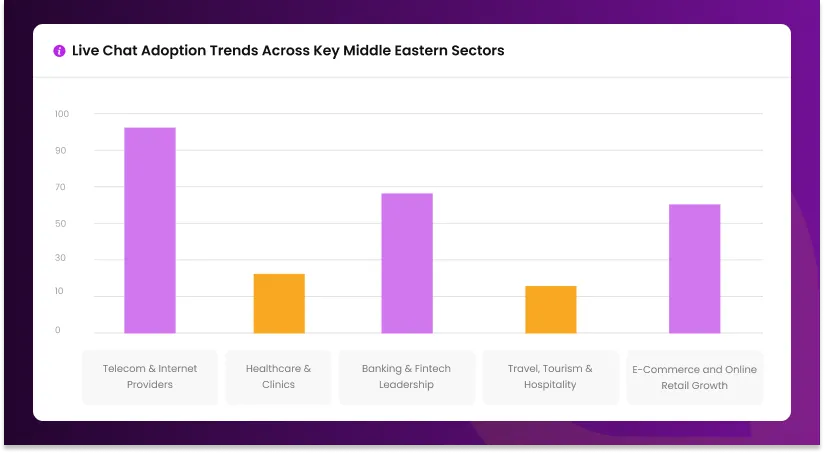
A bar chart titled Live Chat Adoption Trends Across Key Middle Eastern Sectors, with telecom showing the highest rate.

Travel, Tourism, & Hospitality

The tourism sector is highly dependent on instant connections and live chat is a necessity for airlines, hotel chains, and travel sites. Emirates, Qatar Airways, Etihad Airways, and large hotels are showcasing chat-based support for ticket change requests, booking confirmations and customer care.

Increasingly, tourists like chat support because they want to avoid expensive international calls and chat support can be Mandarin, Arabic, English, or even French or Urdu support for visiting groups of guests.

Healthcare & Clinics

Clinics and hospitals are now using live chats for appointment requests and management, pre-consultation help, insurance queries, and general questions. While chat cannot medically diagnose, a live chat offered as administrative support improves a patient’s experience significantly.

Telehealth platforms and digital pharmacy services in the UAE and KSA are also using chatbots to walk patients through registration support, prescription refills, and follow-ups.

Telecom & Internet Providers

Telecom companies in the MENA region receive extremely high volumes of inquiries. Live chat is fast and low-cost to help customers with issues compared to a traditional call center. Many of the telecom providers in the region, like Etisalat, STC, Ooredoo, and Batelco rely on artificial intelligence to chat and help customers resolve their issues, like trouble with SIM cards and payment issues.


Cultural Factors Supporting Live Chat Growth

Digital transformation is a main factor driving the use of live chat conversations in the region, but cultural factors are nearly as impactful.

The Faster and More Respectful Communication Preference

Middle Eastern consumers care deeply about hospitality and speed, but live chat gives consumers polite, instant answers as consumers expect good service.

Privacy Matters

Many customers prefer live chat over a phone conversation for privacy reasons, efficacy for sensitive issues, such as financial or account-based issues. Live chat gives a veil over communication for privacy the consumer may prefer with a brand.

Shopping at Night

In many regions, particularly in the context of peak-time, consumers use their online sources during the day or afternoons, consumers shop at night. In the Middle East, consumers tend to browse and shop late at night. Using live chat, particularly AI live chat, guarantees that brands are visibly present and available late into traditional business hours.
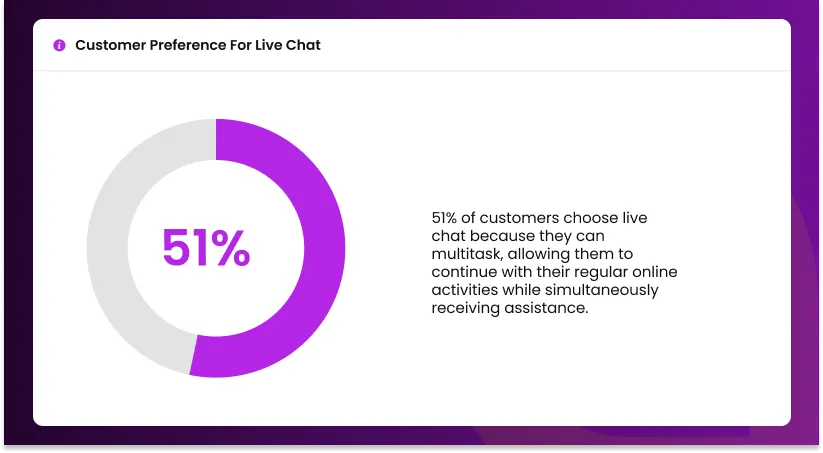
A circular graphic showing that 51% of customers choose live chat due to the ability to multitask.

The Middle East is a melting pot of residents and tourists who speak many different languages. Great brands should offer live chat options that can speak Arabic, English, Hindi, Urdu, etc., for customer service options.

Trust happens through sounding human

Consumers welcome the idea of automation as it pertains to engaging with a service, but there is still a welcome for the human touch that customers prefer. Live chat creates a scenario where automated response is instant and easy, with the option to be transferred to a living human customer service representative.


Challenges Slowing Adoption — Solutions

Regardless of the clearly defined benefits of live chat, some businesses in the Middle East still hesitate to adopt live chat due to similar misconceptions. The most common is that live chat is expensive and only for big companies—if you’re a small to medium-sized business with an online presence or a smaller company seeking to grow your business, live chat is an easy and affordable option, and companies like Chattrik have solutions for you. Another assumption is that you don’t have enough people to chat with customers, and that’s the case when inquiring through chat; AI handles a large part of customer inquiries, so many companies don’t need large teams to engage in live chat.

Many companies assume that customers still prefer phones, but the data does not support that assumption—young consumers in the Middle East, in particular, prefer chat-based support, and the mobile world has changed how consumers prefer to engage with businesses. Others think Arabic support will be an issue; however, modern live chat systems are built to support Arabic scripts, dialects, and RTL interfaces. Lastly, there is a misconception that automation does not seem like it is there to help. With proper customization, tone, and conversational design, AI chatbots can feel like they are engaging with humans, and they are engaging with clients with empathy and can even move live agents into the conversation—provided organizations engage with live agents when conversations become human.


Why Chattrik Is the Ideal Live Chat Solution for Middle Eastern Businesses

Chattrik is designed for businesses based in the Middle East, providing an AI-assisted chat solution to simplify customer interaction while enhancing service. Both integration and setup are quick and straightforward, allowing businesses to integrate live chat setup in minutes and without any technical complexity. The AI chatbots automatically reply, create tickets, and route inquiries, allowing for 24/7 support while diminishing agent workload.

It allows startups and SMEs in the Middle East to be accessible with the features of live chat. It also includes built-in analytics, which provide key insights and detailed reporting into the customers’ actions, prior interactions, response times, and agent performance. It also helps businesses improve their support strategy. Chat interfaces can all be completely customized, allowing businesses the ability to change colors, greetings, automate messages, and even customize chatbot personalities. Finally, it integrates seamlessly with other platforms, including CRM’s, WhatsApp Business, email, and e-commerce platforms to maintain smooth operations across all customer touchpoints.


The Future of Live Chat in the Middle East

As the Middle East continues its rapid digital transformation, live chat is set to become even more advanced, shaping the future of customer communication across all major industries.

One significant development will be the rise of fully AI-driven customer journeys, where artificial intelligence guides users from initial inquiry to purchase and even after-sales support without human intervention. Another major trend will be predictive customer service—systems capable of identifying needs before customers express them and initiating proactive chat assistance to prevent issues or enhance satisfaction.

The region will also see a stronger push toward omnichannel support, where live chat seamlessly merges with WhatsApp, Instagram DM, Facebook Messenger, and email into a single unified dashboard for smoother operations. Alongside this, businesses will leverage hyper-personalization, using customer data to deliver deeply tailored interactions based on individual behaviors, preferences, and service history. As GCC countries strengthen their digital privacy and data protection regulations, secure and compliant chat platforms like will become even more essential for businesses.

Finally, traditional call centers are expected to evolve into digital-first customer service hubs, powered by AI automation and advanced live chat systems, reducing reliance on phone-based support and significantly improving efficiency across sectors.


Conclusion

The Middle East is one of the fastest-growing digital economies globally, with customers in the region requesting smarter, faster, and personalized service experiences. Live chat checks all of those boxes and beyond. The ability to communicate in real-time, have multi-lingual support, automation, and cultural alignment, making it the ideal mode of communicating for businesses in the region.

If you are an e-commerce company in Dubai, bank in Riyadh, hospital in Doha, or start-up in Bahrain, live chat is no longer optional, but an imperative to build trust and engender customer loyalty.

Live Chat Companies have begun paving the way by providing simple, intelligent, scalable, fully Arabic-supported live chat solutions customized for Middle Eastern businesses.

Is your business ready to deliver faster, smarter, and personalized support across the Middle East? Leverage Chattrik’s intelligent live chat solutions to build trust, loyalty, and lasting customer relationships.